Today we celebrate the appearance day of Sri Caitanya Mahaprabhu. We honor His appearance with a full day fast (until moon rise), followed by a special vegetarian feast. Also to honor the Lord’s appearance day, we have selected these two verses from the Sri Caitanya-caritmrta.
“O most munificent incarnation! You are Kṛṣṇa Himself appearing as Śrī Kṛṣṇa Caitanya Mahāprabhu. You have assumed the golden color of Śrīmatī Rādhārāṇī, and You are widely distributing pure love of Kṛṣṇa. We offer our respectful obeisances unto You.
“We offer our respectful obeisances unto that merciful Supreme Personality of Godhead who has converted all three worlds, which were maddened by ignorance, and saved them from their diseased condition by making them mad with the nectar from the treasure-house of love of God. Let us take full shelter of that Personality of Godhead, Śrī Kṛṣṇa Caitanya, whose activities are wonderful.”
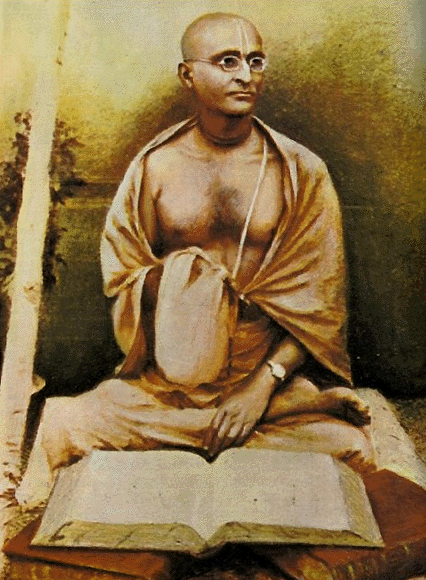
So today we celebrate the Appearance Day of Srila Bhaktisiddhanta Sarasvati Thakura, the Spiritual Master of our Srila Prabhupada. We honor it today with a half day fast a Pushpanjali (offering of prayers and flowers) followed by a nice vegetarian feast.
Srila Bhaktisiddhanta Sarasvati Thakura appeared in Purusottam Ksetra, Jagannatha Puri, Orissa, on February 6, 1874. He was born in the family home next to the Narayan-chhata of Sri Jagannatha Temple, which always reverberated with the chanting of the Holy Name. Named Bimala Prasad, He was the fourth son of Srila Bhaktivinoda Thakura and Srimati Bhagavati Devi.
…Sometimes an ever-liberated personal associate of the Supreme Personality of Godhead descends into this universe just as the Lord descends. Although working for the liberation of conditioned souls, the messenger of the Supreme Lord remains untouched by the material energy. Generally ever-liberated personalities live in the spiritual world as associates of Lord Kṛṣṇa, and they are known as kṛṣṇa-pāriṣada, associates of the Lord. Their only business is enjoying Lord Kṛṣṇa’s company, and even though such eternally liberated persons come within this material world to serve the Lord’s purpose, they enjoy Lord Kṛṣṇa’s company without stoppage. The ever-liberated person who works on Kṛṣṇa’s behalf enjoys Lord Kṛṣṇa’s company through his engagement.
… The conditioned soul subjected to the threefold material miseries is ceaselessly kicked by māyā, and this is his disease. If by chance he meets a saintly person who works on Kṛṣṇa’s behalf to deliver conditioned souls, and if he agrees to abide by his order, he can gradually approach the Supreme Personality of Godhead, Kṛṣṇa.(from purport to Madhya-lila 22.14-15)
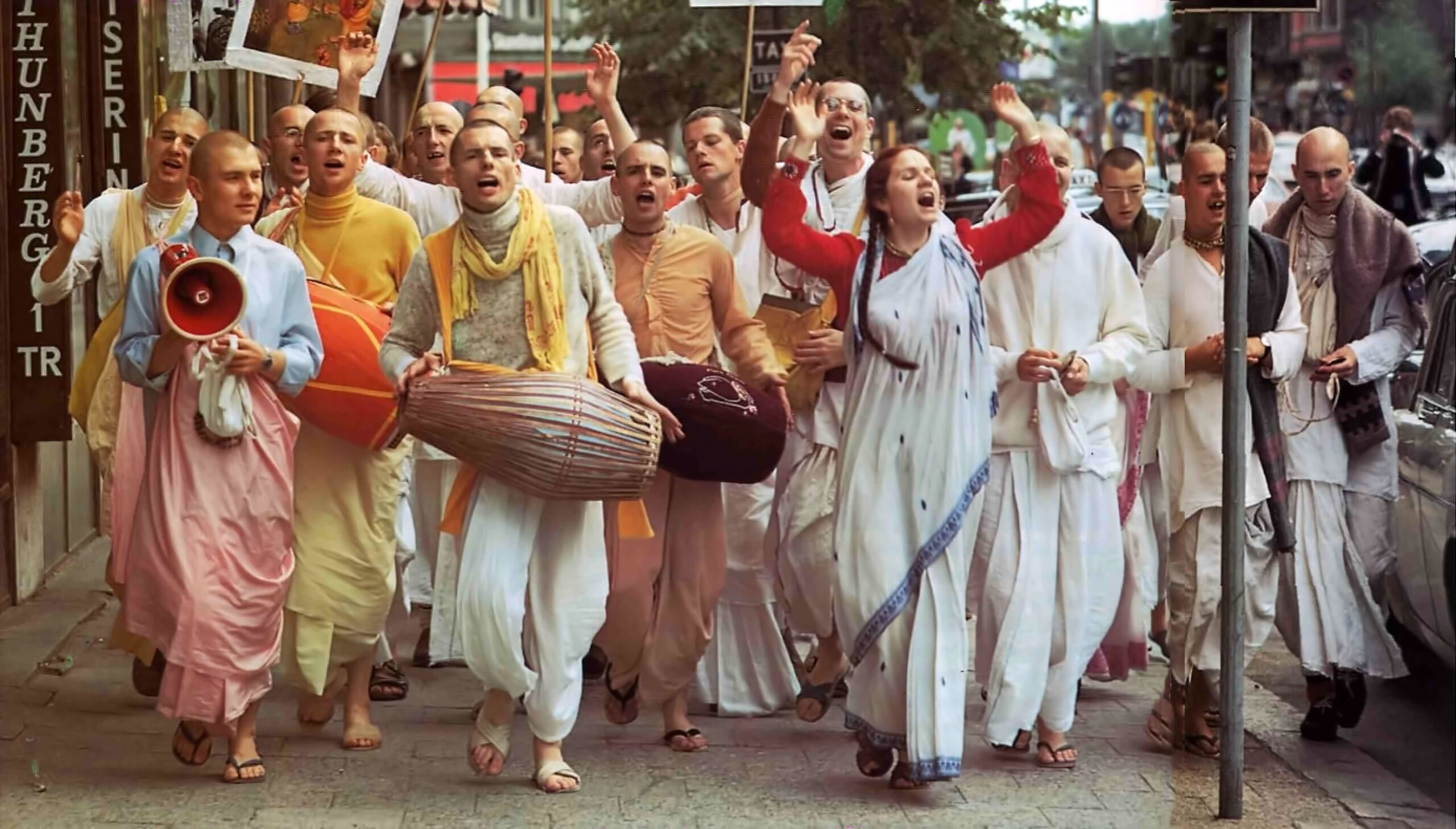
Madhudviṣa: Prabhupāda, when we’re out on saṅkīrtana, chanting, what would be the best way for us to engage the crowd to become participants in the chant with us? What would be the best of…
Prabhupāda: “Best way you go on chanting. Your business is not to, I mean to say, satisfy the crowd. Your business is satisfy Kṛṣṇa, and then crowd will be automatically satisfied. We are not going to please the crowd. We are going to give them something, Kṛṣṇa. So you should be very much careful whether you are delivering Kṛṣṇa in the right way. Then they’ll be satisfied. Your only business should be to satisfy Kṛṣṇa. Then everything will be satisfied. Tasmin tuṣṭe jagat tuṣṭa. If Kṛṣṇa is satisfied, then whole world is satisfied. If you pour water on the root, then it is automatically distributed in every parts of the tree. So Kṛṣṇa is the big tree, root of the big tree, and you take to watering Kṛṣṇa, chant Hare Kṛṣṇa and follow the rules and regulation, everything will be all right.” (Srila Prabhupada’s Lecture : Bhagavad-gita 7.1 – Los Angeles, December 2, 1968 )
I have been reading through some of the many letters written by Srila Prabhupada to his disciples. It is interesting to me how he deals with every disciple in such a personal and intimate way. How he gently instructs on behavior, while at the same time presenting the philosophy of Krishna consciousness,in such a clear, and matter of fact way.
Letter to Hamsaduta
February 09, 1969
My Dear Hamsaduta,
Please accept my blessings. I am in due receipt of your letter of January 30, 1969, and I have noted the contents carefully. I am pleased to note that you are seeing into obtaining a dictaphone for helping me in preparing so many Krishna Consciousness literatures. The maker of my present dictaphone is Grundig, and it is an Embassy de Jur, Sterorette. This model was purchased by Hayagriva in New York for $190 by cash payment, but it can be had by installment payment at a higher price. So you may do the needful in this matter.
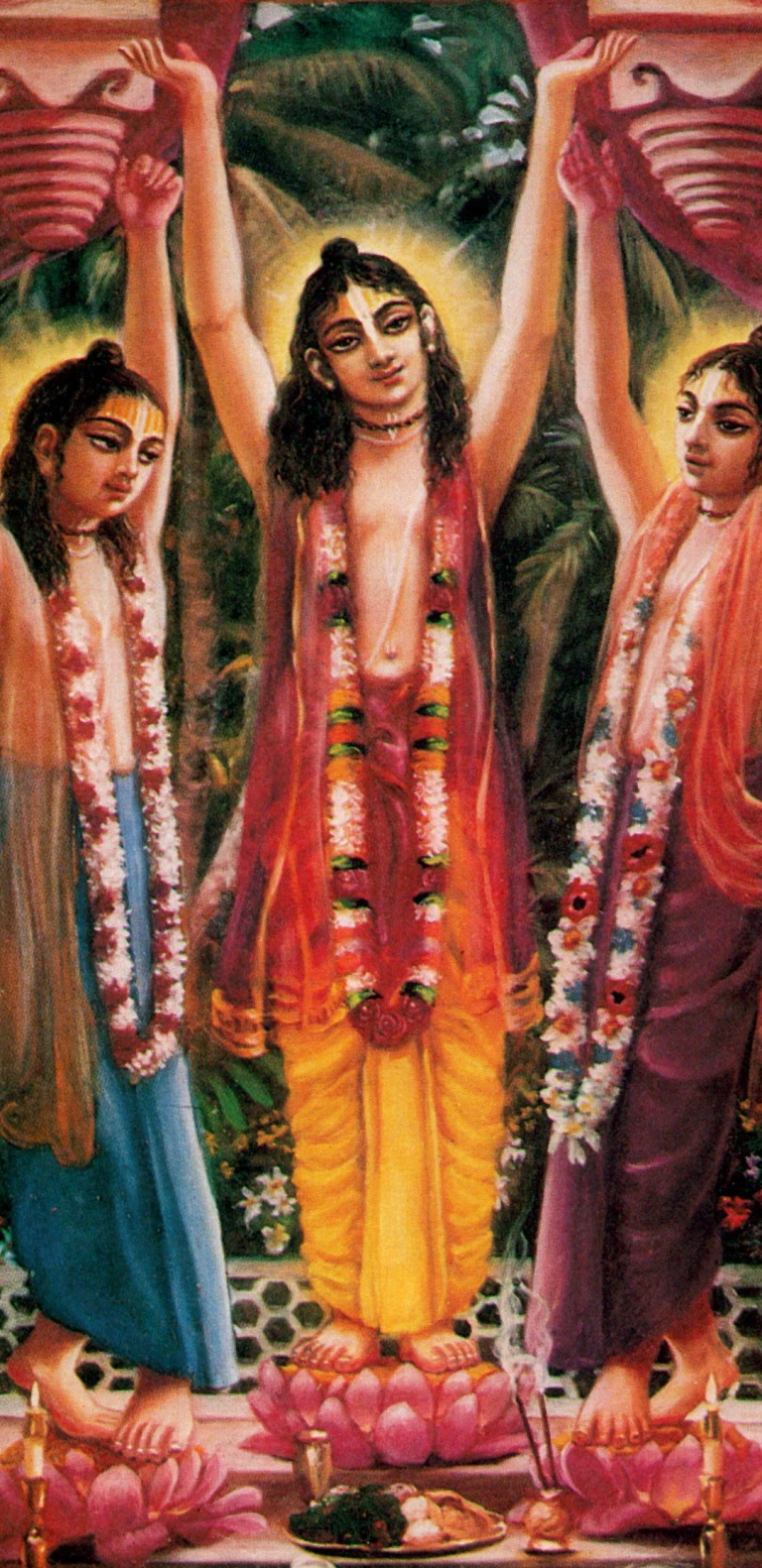
Regarding the Panca-tattva picture, it is simply a pose of Lord Caitanya and some of His associates receiving service from Their devotees and chanting Hare Krishna. Panca-tattva is described as Krishna in five expansions, namely Krishna Himself in the role of a devotee; His Incarnation in the role of a devotee; His energy in the role of a devotee; His expansion in the role of a devotee; and His two energies (internal and marginal) in the role of devotees. So the external energy is not there. Therefore the whole manifestation is transcendental. There are three energies, namely internal, external, and marginal. Although all of the energies are connected with Krishna, the external energy is differentiated. Just like darkness is another part of light, and therefore darkness can not stand before the light, but it stands somewhere by the side of the light. Without light, there is no existence of darkness, but darkness cannot be found in the light. Similarly, there is no darkness or activities of the external energy in the Pastimes of Lord Caitanya.
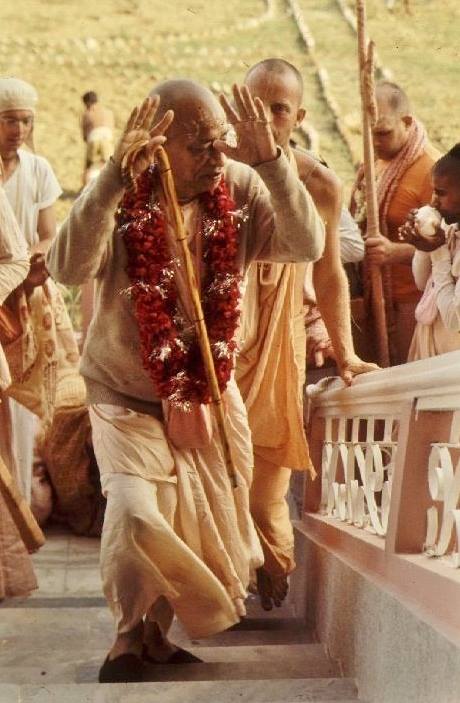
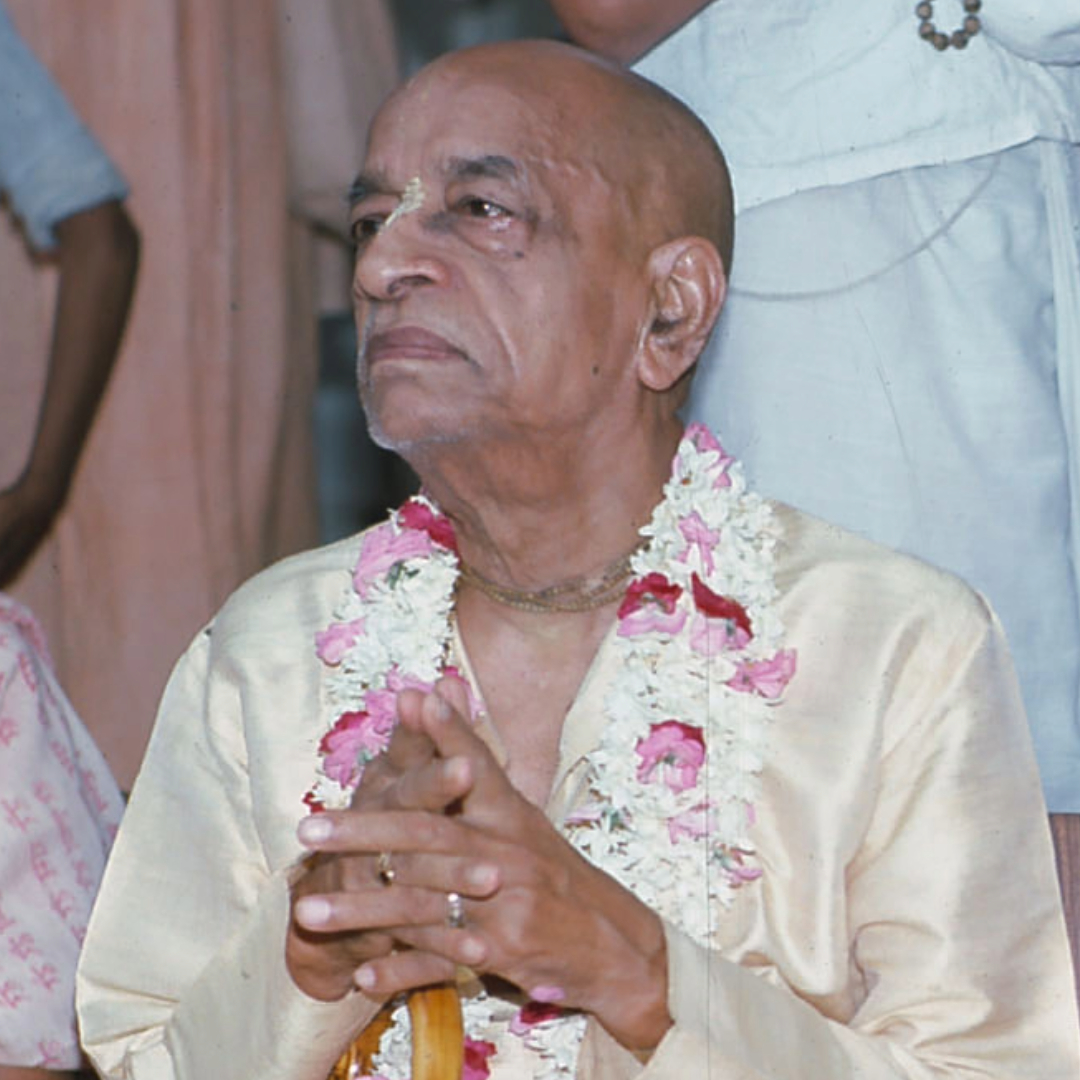
I just wanted to post this beautiful picture of Srila Prabhupada.
I was reading one letter Srila Prabhupada had written to Tribhuvanatha das this morning, and I am always amazed how patient and encouraging Srila Prabhupada was with all his disciples.
Letter to: Tribhuvanatha Los Angeles 16 June, 197272-06-16
My Dear Tribhuvanatha,
Please accept my blessings. I am in due receipt of your letter dated 10th June, 1972, and with great pleasure I have noted the contents. I was wondering what you are doing, so I am very glad to hear your report of getting the very nice temple in Edinburgh. I think it is Krishna’s desire that you have got that place in such perfect location, so now apply yourself very seriously and take advantage of this opportunity for spreading Krishna Consciousness all over that city and in other places in Scotland. The price of 13 Pounds a week for such a large place is not at all bad. Yes, take the place for as many years as they will agree to.
Because there is close proximity of many students, the important thing to give them is our book and literature. They are interested to get knowledge, but the materialistic knowledge will lead them astray from real goal of their intelligence, and all of their credits in education will only add up to so many zeros. But if you yourself are very much well-acquainted with our Krishna philosophy, you will be able to convince them that if they make Krishna or God the center of their learning process, never mind they’re scientists, chemists, politicians, whatever they may be, if they put Krishna in front of so many zeros they will come out with a huge sum and their life will be very much perfect…
I always like going back to the letters written by Srila Prabhupada. He explains so nicely and patiently the philosophy of Krsna consciousness.
Dear Brian Marvin,
Please accept my blessings. I beg to acknowledge receipt of your long letter dated February 14, 1974 and I have examined the contents.
Your first question is, how can the Vedas be considered eternal since they contain many historical references? But history is also eternal…There is a saying, “History repeats itself.” Why make a distinction between history and eternity. Things are happening eternally; this is history.
…You have further questioned how the Vedas can be 3,000 B. C. in age. Modern historians cannot pick up when the Vedas came into existence. From our historical references, however, we understand the Vedic knowledge has been current since the time of creation but the knowledge was originally accepted in disciplic succession from spiritual master to disciple. Later, when Vyasadeva found the peoples’ memories decreasing he wrote it into language. Otherwise it was existing by sruti, or hearing. So when this hearing began there is no history. He simply recorded the sruti, and there is no question of change. We have to understand Vedic knowledge on the authority of the disciplic succession not from mental speculators who are simply rascals and have no entrance into the Vedic knowledge. (Letter to Brian Marvin 1974, March 15)
The Nine Processes of Devotional Service are described by Prahlada Maharaja in the 7th Canto of the Srimad Bhagavatam, chapter 5, text 23-24. The great personalities who attained perfection by practice of the nine processes are listed below, followed by the complete text and purport, describing in full these nine processes. If I am not mistaken, this purport to text 23-24 from the seventh canto, chapter five, is one of the longest in the entire Srimad Bhagavatam. Stressing the importance of the verse.
Prahlāda Mahārāja said: Hearing and chanting about the transcendental holy name, form, qualities, paraphernalia and pastimes of Lord Viṣṇu, remembering them, serving the lotus feet of the Lord, offering the Lord respectful worship with sixteen types of paraphernalia, offering prayers to the Lord, becoming His servant, considering the Lord one’s best friend, and surrendering everything unto Him (in other words, serving Him with the body, mind and words)—these nine processes are accepted as pure devotional service. One who has dedicated his life to the service of Kṛṣṇa through these nine methods should be understood to be the most learned person, for he has acquired complete knowledge. (SB 7.5.23-24)
1. HEARING (sravanam) Maharaja Pariksit(the last seven days of his life, he constantly heard the Srimad Bhagavatam).
2. CHANTING (kirtanam) Sukadeva Goswami(spoke the Bhagavatam to Maharaja Pariksit)
3. REMEMBERING (visnu smaranam) Prahlada Maharaja(never forgot Krsna despite constant tortures from his father- Hiranyakashipu)
4. SERVING THE LORD’S LOTUS FEET (pada sevanam) Laxmi, the Goddess of Fortune, is always engaged in serving the lotus feet of the Lord.
5. DEITY-WORSHIP (arcanam) Maharaja Prthu used all of his royal possessions in order to offer them in pure devotion to the Lord.
6. PRAYING (vandanam) Akura offered prayers to Krsna when he was traveling to Vrndavana in order to see Krsna.
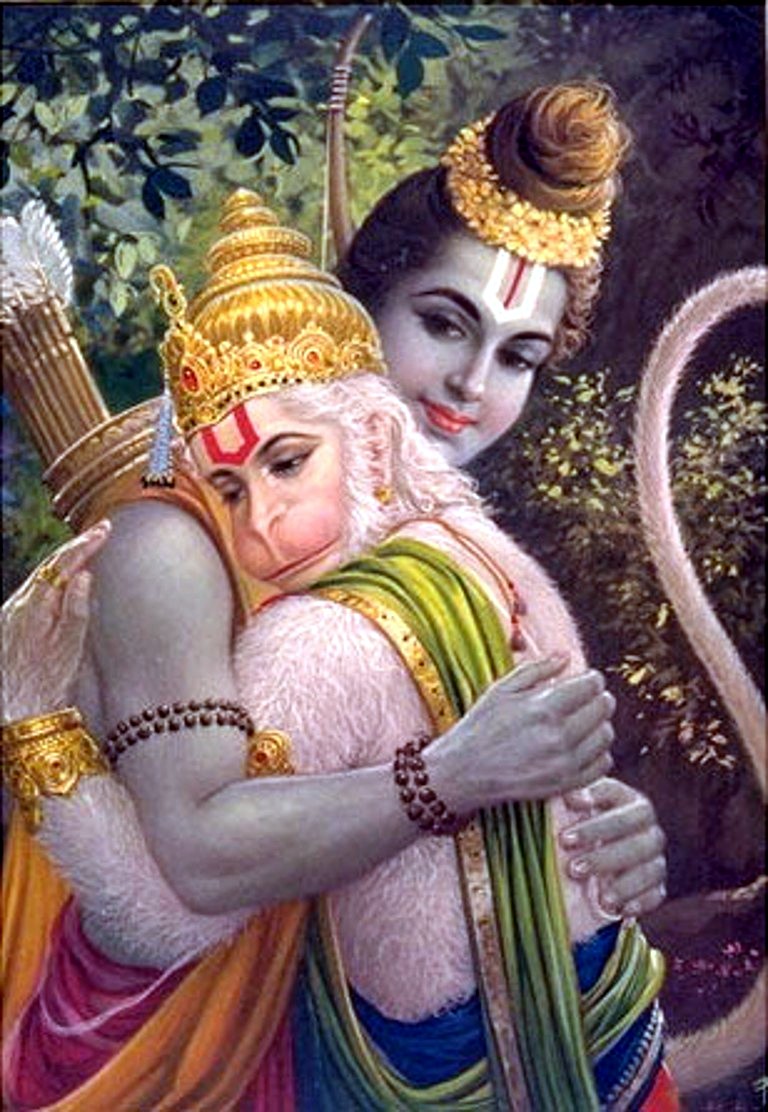
7. EXECUTING ORDERS (dasyam) Hanuman, the intimate servant of Ramacandra executed all of Sri Ramacandra’s orders despite all kinds of difficulties.
8. SERVING AS A FRIEND (sakhyam) Arjuna was so close to Krsna, that the Lord offered Himself to become his chariot driver and serve Arjuna and his brothers in various ways.
9. COMPLETE SURRENDER (atma nivedanam) Bali Maharaja gave Sri Vamanadeva his entire kingdom, his possessions as well as his own body, although his own spiritual master was against it.
All these great devotees served the Lord according to a particular process, but every one of them attained salvation and became eligible to return home, back to Godhead
…Almost every Vaisnava and aspiring Vaisnava in the Western world is indebted to Srila Prabhupada, who made the ultimate sacrifice for us all. No matter our personal doubts, at least we can afford him the respect and love that he so rightly earned and so richly deserves in a public forum read by people all over the world.
Respecting Srila Prabhupada
by Padmapani Prabhu
As disciples and followers of His Divine Grace A.C. Bhaktivedanta Swami Prabhupada, Founder-Acarya of the International Society for Krsna Consciousness, we all have an eternal debt to Srila Prabhupada for his unprecedented sacrifice in freely distributing the mercy of Lord Caitanya Mahaprabhu all over the world.
At great personal inconvenience, Srila Prabhupada left the peaceful and holy village of Vrindavan at the advanced age of 69 to travel by steamship across the Atlantic Ocean, suffering two heart attacks en route to New York City and arriving with less than seven dollars in his pocket and with no help from anyone except his beloved Lord Sri Krsna. Almost immediately upon his arrival after more than 30 days at sea — traveling by freighter and not by plane or luxury cruiser — Prabhupada began his preaching work as ordered by his spiritual master, His Divine Grace Srila Bhaktisiddhanta Sarasvati Thakura. Rather than focus on the wealthy or privileged class of society, Srila Prabhupada — an educated and scholarly master of the Vedic literatures — chose to humbly deliver his message to the poorest of the poor in the Bowery and later in the Lower East Side of New York City. In spite of his exalted position as an authorized representative of the highly esteemed Brahma-Madhva-Gaudiya-Sampradaya in direct disciplic succession from the Supreme Personality of Godhead, Lord Sri Krsna, Srila Prabhupada always remained humble and respectful to everyone — especially to those whom he endeavored so hard to help with his personal instructions, encouragement and unlimited patience:
“I am very poor and I have nothing to return for your loving service, but I can simply pray to Krishna for your gradual advancement in Krishna Consciousness. I think that is the best blessing which we can have in this material existence.” (Srila Prabhupada letter, October 21, 1968)