It All Rests on the Supreme Will of the Lord

nuclear weapon

This morning I was reading from the Srimad Bhagavatam, First Canto, Chapter 7, entitled “The Son of Drona Punished”. This chapter has always intrigued me, because although the Srimad Bhagavatam was compiled by Srila Vyasedeva five thousand years ago, there is mention of the ultimate weapon, the brahmāstra [nuclear weapon] being used. We think that Atomic energy or Nuclear energy is some modern technological advancement, but actually this knowledge has been around since the time that Srimad Bhagavatam was first spoken, many thousands of years ago.

…The brahmāstra is similar to the modern nuclear weapon manipulated by atomic energy. The atomic energy works wholly on total combustibility, and so the brahmāstra also acts. It creates an intolerable heat similar to atomic radiation, but the difference is that the atomic bomb is a gross type of nuclear weapon, whereas the brahmāstra is a subtle type of weapon produced by chanting hymns. It is a different science, and in the days gone by such science was cultivated in the land of Bhārata-varṣa. The subtle science of chanting hymns is also material, but it has yet to be known by the modern material scientists. Subtle material science is not spiritual, but it has a direct relationship with the spiritual method, which is still subtler. A chanter of hymns knew how to apply the weapon as well as how to retract it. That was perfect knowledge. (from purport to SB 1.7.28)

…The theory that the modern atomic bomb explosions can annihilate the world is childish imagination. First of all, the atomic energy is not powerful enough to destroy the world. And secondly, ultimately it all rests on the supreme will of the Supreme Lord because without His will or sanction nothing can be built up or destroyed. It is foolish also to think that natural laws are ultimately powerful. Material nature’s law works under the direction of the Lord, as confirmed in the Bhagavad-gītā. The Lord says there that natural laws work under His supervision. The world can be destroyed only by the will of the Lord and not by the whims of tiny politicians. Lord Śrī Kṛṣṇa desired that the weapons released by both Drauṇi and Arjuna be withdrawn, and it was carried out by Arjuna at once. Similarly, there are many agents of the all-powerful Lord, and by His will only can one execute what He desires. (from purport to 1.7.32)

Continue reading →
The Power of the Holy Name

The story of Ajamila, is one most of us remember, because at the time of his death he chanted the Holy Name of the Lord, and was saved. Actually, he was thinking of his son whose name was Narayana (another name of Krishna), but because he chanted one of the Lords many names, he was saved from the Yamadutas. That is the power of the Holy Name.

Ajāmila has already atoned for all his sinful actions. Indeed, he has atoned not only for sins performed in one life but for those performed in millions of lives, for in a helpless condition he chanted the holy name of Nārāyaṇa. Even though he did not chant purely, he chanted without offense, and therefore he is now pure and eligible for liberation. (SB 6.2.7)

Purport

The Yamadūtas had considered only the external situation of Ajāmila. Since he was extremely sinful throughout his life, they thought he should be taken to Yamarāja and did not know that he had become free from the reactions of all his sins. The Viṣṇudūtas therefore instructed that because he had chanted the four syllables of the name Nārāyaṇa at the time of his death, he was freed from all sinful reactions. In this regard Śrīla Viśvanātha Cakravartī Ṭhākura quotes the following verses from the smṛti-śāstra:

nāmno hi yāvatī śaktiḥ
pāpa-nirharaṇe hareḥ
tāvat kartuṁ na śaknoti
pātakaṁ pātakī naraḥ

“Simply by chanting one holy name of Hari, a sinful man can counteract the reactions to more sins than he is able to commit.” (Bṛhad-viṣṇu Purāṇa)

avaśenāpi yan-nāmni
kīrtite sarva-pātakaiḥ
pumān vimucyate sadyaḥ
siṁha-trastair mṛgair iva

“If one chants the holy name of the Lord, even in a helpless condition or without desiring to do so, all the reactions of his sinful life depart, just as when a lion roars, all the small animals flee in fear.” (Garuḍa Purāṇa)

sakṛd uccāritaṁ yena
harir ity akṣara-dvayam
baddha-parikaras tena
mokṣāya gamanaṁ prati

“By once chanting the holy name of the Lord, which consists of the two syllables ha-ri, one guarantees his path to liberation.” (Skanda Purāṇa)

These are some of the reasons why the Viṣṇudūtas objected to the Yamadūtas’ taking Ajāmila to the court of Yamarāja.

The Songs of the Queens at Dvaraka

I found this in Srila Prabhupada’s purport to Sri Caitanya-caritmrta Antya-lila 19.108. The real beauty of Srila Prabhupada’s books lies in his purports. Always so much nectar.

The songs of the queens at Dvārakā, which are mentioned at the end of the Tenth Canto of Śrīmad-Bhāgavatam, have a very special meaning. They are not understood even by the most learned scholars. (Cc. Antya 19.108)

If one becomes a servant of the servants of Śrī Caitanya Mahāprabhu and Lord Nityānanda Prabhu and is favored by Them, he can believe in all these discourses. (Cc. Antya 19.109)

Just try to hear these topics with faith, for there is great pleasure even in hearing them. That hearing will destroy all miseries pertaining to the body, mind and other living entities, and the unhappiness of false arguments as well. (Cc. Antya 19.110)

The Songs of the Queens at Dvaraka

Purport

These songs of Śrīmad-Bhāgavatam are verses 15-24 of the Ninetieth Chapter of the Tenth Canto.

kurari vilapasi tvaṁ vīta-nidrā na śeṣe
svapiti jagati rātryām īśvaro gupta-bodhaḥ
vayam iva sakhi kaccid gāḍha-nirbhinna-cetā
nalina-nayana-hāsodāra-līlekṣitena

All the queens incessantly thought of Kṛṣṇa. After their pastimes in the water, the queens said, “Our dear friend the osprey, Kṛṣṇa is now asleep, but we stay awake at night because of Him. You laugh at us when you see us awake at night, but why are you not sleeping? You seem absorbed in thoughts of Kṛṣṇa. Have you also been pierced by Kṛṣṇa’s smile? His smile is very sweet. One who is pierced by such an arrow is very fortunate.”

Continue reading →

Advent of Kali Yuga

Kali Yuga is the fourth and shortest Yuga in the cycle of four ages (Satya, Treta, Dvapara, and Kali), lasting 432,000 human years. Kali Yuga is said to last for 432,000 years, with approximately 5,000 years already passed. As stated in Bhagavad-gītā, the Lord descended to the earth for the protection of the faithful and annihilation of the impious, so after the Battle of Kurukṣetra and establishment of Mahārāja Yudhiṣṭhira, the mission of the Lord was complete. The Advent of Kali Yuga began after the departure of Lord Krishna.

Srimad Bhagavatam

Disappearance of Lord Krishna

by His Divine Grace A. C. Bhaktivedanta Swami Prabhupada

Canto 1, Chapter 14, Text 3

kālasya ca gatiṁ raudrāṁ
viparyastartu-dharmiṇaḥ
pāpīyasīṁ nṛṇāṁ vārtāṁ
krodha-lobhānṛtātmanām

kālasya — of eternal time; ca — also; gatim — direction; raudrām — fearful; viparyasta — reversed; ṛtu — seasonal; dharmiṇaḥ — regularities; pāpīyasīm — sinful; nṛṇām — of the human being; vārtām — means of livelihood; krodha — anger; lobha — greed; anṛta — falsehood; ātmanām — of the people.Translation

He saw that the direction of eternal time had changed, and this was very fearful. There were disruptions in the seasonal regularities. The people in general had become very greedy, angry and deceitful. And he saw that they were adopting foul means of livelihood.

Purport

When civilization is disconnected from the loving relation of the Supreme Personality of Godhead, symptoms like changes of seasonal regulations, foul means of livelihood, greed, anger and fraudulence become rampant. The change of seasonal regulations refers to one season’s atmosphere becoming manifest in another season — for example the rainy season’s being transferred to autumn, or the fructification of fruits and flowers from one season in another season. A godless man is invariably greedy, angry and fraudulent. Such a man can earn his livelihood by any means, black or white. During the reign of Mahārāja Yudhiṣṭhira, all the above symptoms were conspicuous by their absence. But Mahārāja Yudhiṣṭhira was astonished to experience even a slight change in the godly atmosphere of his kingdom, and at once he suspected the disappearance of the Lord. Foul means of livelihood implies deviation from one’s occupational duty. There are prescribed duties for everyone, such as the brāhmaṇa, kṣatriya, vaiśya and śūdra, but anyone who deviates from his prescribed duty and declares another’s duty to be his own is following a foul and improper duty. A man becomes too greedy for wealth and power when he has no higher objective in life and when he thinks that this earthly life of a few years is all in all. Ignorance is the cause for all these anomalies in human society, and to remove this ignorance, especially in this age of degradation, the powerful sun is there to distribute light in the shape of Śrīmad-Bhāgavatam.

Original Editions

Over the years, I have been all over the internet, looking at devotee web pages, and searching out Srila Prabhupada’s Original Books. There are many fine sites indeed, offering free downloads, and online reading, etc. But there is one Site in particular, I highly recommend. I happened upon it by chance one day when I typed in Prabhupada in the search bar.

The site is simply called Srila Prabhupada https://prabhupada.io/

They have one page I am very encouraged to see, when you click on the category “Library”, Srila Prabhupada’s Original books come up. Every word as Prabhupāda published it — the books exactly as they went to the printer in his own lifetime.

Original Editions https://prabhupada.io/books

“I Have Instructed Everything in My Books.”

Srila Prabhupada wrote and published over 80 volumes of spiritual literature which he considered to be his most important contribution. Despite the heavy demands of establishing and managing a worldwide movement, Srila Prabhupada never failed to rise early in the morning to perform his beloved writing work. He applied great devotion and care in translating the ancient Vedic literatures into English from the original Sanskrit and Bengali languages. He would then dictate his famous “Bhaktivedanta Purports,” further explaining the meaning of each verse and its relevance to the modern age. Prabhupada’s books are highly acclaimed by scholars and students alike (see reviews below). They have been translated into more than 60 languages and have been sold in the hundreds of millions. The PrabhupadaConnection encourages everyone to take advantage of these timeless literatures which are full of spiritual knowledge and potency.
.
Books by
His Divine Grace A.C. Bhaktivedanta Swami Prabhupada
.
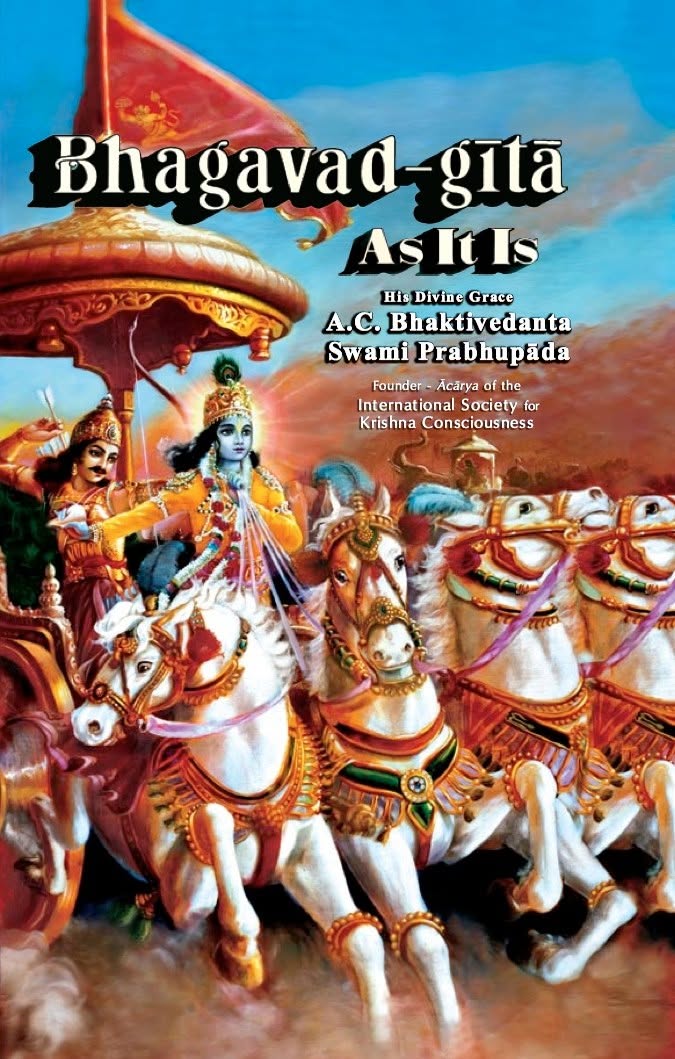
Bhagavad-gita As It Is
Srimad-Bhagavatam, cantos 1-10, (29 vols.)
Sri Caitanya-caritamrta (17 vols.)
Teachings of Lord Caitanya
The Nectar of Devotion
Sri Isopanisad
Easy Journey to Other Planets
Krsna Consciousness: The Topmost Yoga System
Krsna, the Supreme Personality of Godhead (3 vols.)
Perfect Questions, Perfect Answers
Dialectical Spiritualism—A Vedic View of Western Philosophy
Teachings of Lord Kapila, the Son of Devahuti
Transcendental Teachings of Prahlad Maharaja
Teachings of Queen Kunti
Krsna, the Reservoir of Pleasure
The Science of Self-Realization
The Path of Perfection
Life Comes From Life
The Perfection of Yoga
Beyond Birth and Death
On the Way to Krsna
Raja-vidya: The King of Knowledge
Elevation to Krsna Consciousness
Krsna Consciousness: The Matchless Gift
Back to Godhead magazine (founder)
Scholars Review Srila Prabhupada’s Books

Continue reading →

Divine Ecstasies

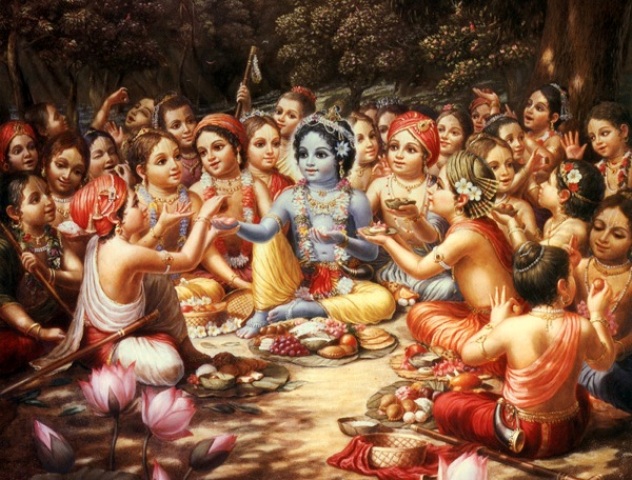
Krsna & the cowheard boys taking Prasadam

Today, being Monday, and the start of another workday week, I wanted to focus my mind, not on all the work ahead, but rather, on some Krishna Nectar from Srila Prabhupada’s Srimad Bhagavatam. We share with you a few of Srila Prabhupada’s divine ecstasies. As we mentioned is a previous post, there are two kṛṣṇa-kathās; narrations spoken by Kṛṣṇa, and narrations spoken about Kṛṣṇa. Please note text 5 & 6 which is spoken by Krsna.

…devotees who have accepted the essence of life, are attached to Kṛṣṇa in the core of their hearts, and He is the aim of their lives. It is their nature to talk only of Kṛṣṇa at every moment, as if such topics were newer and newer.

Like the whorl of a lotus flower surrounded by its petals and leaves, Kṛṣṇa sat in the center, encircled by lines of His friends, who all looked very beautiful. Every one of them was trying to look forward toward Kṛṣṇa, thinking that Kṛṣṇa might look toward him. In this way they all enjoyed their lunch in the forest.

Among the cowherd boys, some placed their lunch on flowers, some on leaves, fruits, or bunches of leaves, some actually in their baskets, some on the bark of trees and some on rocks. This is what the children imagined to be their plates as they ate their lunch.

Srimad Bhagavatam
By His Divine Grace A. C. Bhaktivedanta Swami Prabhupada
Canto 10, Chapter 13, Text 1-12

Translations and purports

Continue reading →

In the Age of Kali

Kali Yuga
Kali Yuga

O learned one, in this iron age of Kali men have but short lives. They are quarrelsome, lazy, misguided, unlucky and, above all, always disturbed. (SB 1.1.10)

This morning as I was reading from the Srimad Bhagavam, and Srila Prabhupada was describing the symptoms of this age.

…In Kali-yuga, the duration of life is shortened not so much because of insufficient food but because of irregular habits. By keeping regular habits and eating simple food, any man can maintain his health. Overeating, over-sense gratification, overdependence on another’s mercy, and artificial standards of living sap the very vitality of human energy. Therefore the duration of life is shortened.

The people of this age are also very lazy, not only materially but in the matter of self-realization.

In this age, men are victims not only of different political creeds and parties, but also of many different types of sense-gratificatory diversions, such as cinemas, sports, gambling, clubs, mundane libraries, bad association, smoking, drinking, cheating, pilfering, bickerings, and so on. Their minds are always disturbed and full of anxieties due to so many different engagements… In the Kali-yuga the whole atmosphere is surcharged with faithlessness. Men are no longer interested in spiritual values. Material sense gratification is now the standard of civilization.

Although it is indeed a difficult age to live in, still there is a solution. In this First Chapter of Srimad Bhagavatam;

…The sages of Naimiṣāraṇya are anxious to disentangle all fallen souls, and here they are seeking the remedy from Śrīla Sūta Gosvāmī.

Full Text and Purport

Continue reading →

The Glories of Maharaja Pariksit

This morning I was reading about Maharaja Pariksit and of his qualities and position in life. He was in a position to enjoy life to the fullest extent,then why should he give up all these favorable circumstances and sit down on the bank of the Ganges, fasting till death? This is astonishing, and therefore all were eager to know the cause. He gave up everything to hear Sriman Bhagavatam from the lips of the pure devotee.

He was a great emperor and possessed all the opulences of his acquired kingdom. He was so exalted that he was increasing the prestige of the Pāṇḍu dynasty. Why did he give up everything to sit down on the bank of the Ganges and fast until death?

…There was nothing undesirable in his life. He was quite a young man and could enjoy life with power and opulence. So there was no question of retiring from active life. There was no difficulty in collecting the state taxes because he was so powerful and chivalrous that even his enemies would come to him and bow down at his feet and surrender all wealth for their own benefit. Mahārāja Parīkṣit was a pious king. He conquered his enemies, and therefore the kingdom was full of prosperity. There was enough milk, grains and metals, and all the rivers and mountains were full of potency. So materially everything was satisfactory. Therefore, there was no question of untimely giving up his kingdom and life. The sages were eager to hear about all this.

Continue reading →

In the Age of Kali-yuga… There is Still One Good Thing…

We all have our favorite quotes and slokas from the pages of Srila Prabhupada’s books. One of mine is the following:

“My dear King, although Kali-yuga is full of faults, there is still one good quality about this age. It is that simply by chanting the Hare Kṛṣṇa mahā-mantra, one can become free from material bondage and be promoted to the transcendental kingdom.” (Bhāg. 12.3.51)

Srila Prabhupada quotes this partictular verse from the Bhagavatam many times in his lectures, conversations, books etc., for instance:

“In the sastra it is said this Kali-yuga is full of faults, so many faults. It is the ocean of faults. But there is a very nice thing, asti hy eko mahan gunah, a very great quality. What is that? Kirtanad eva krsnasya mukta-sangah param vrajet [SB 12.3.51]. If you simply chant Hare Krishna mantra, then you become perfect. Is it very difficult? Chant Hare Krishna and you become perfect. But we are so unfortunate, we are not even prepared to chant. This is our position. So you have to make little determination that ‘I shall chant henceforward Hare Krishna mantra.’ Then everything is all right.”

Continue reading →