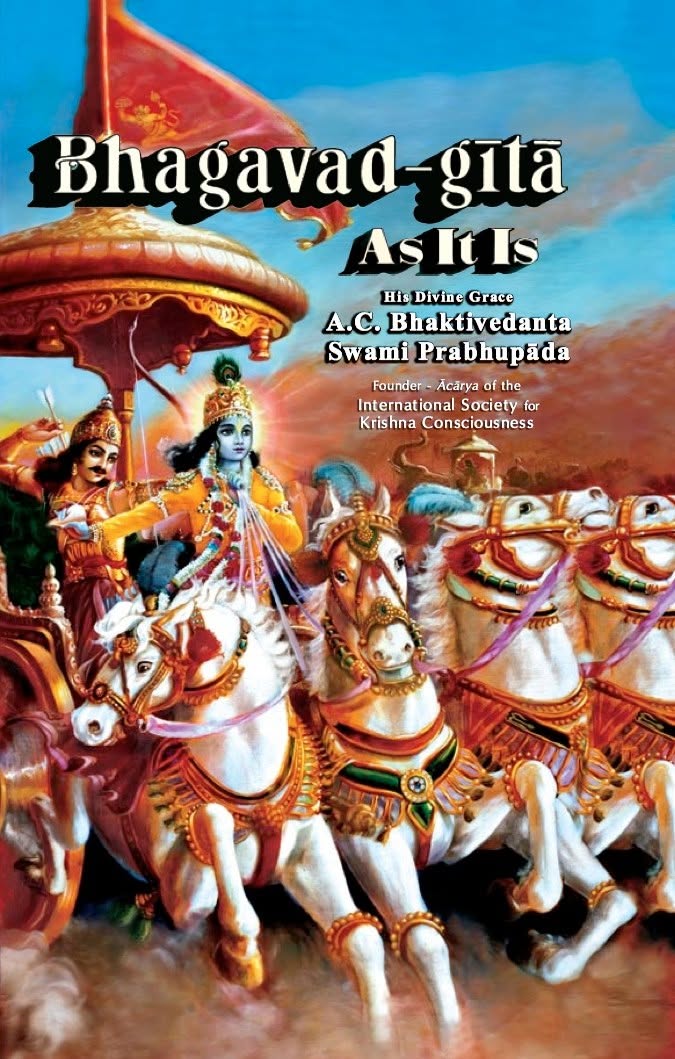
The Month of Damodara (Kartika)

Today marks the begining of the month of Kartika, or as I like to say, the month of Damodara. As always during this month, we sing the Damodara prayers (Sri Damodararastaka) daily and light a candle to offer. It is also a good time to read from the KRSNA Book and just delight in the childhood pastimes of Lord Krishna.

Included below are the lyrics and translations from the original “Songs of the Vaisnava Acaryas” song book.

Sri Damodarastaka
from “Songs of the Vaisnava Acaryas” 1974 Edition

namāmīśvaraḿ sac-cid-ānanda-rūpaḿ
lasat-kuṇḍalaḿ gokule bhrājamanam
yaśodā-bhiyolūkhalād dhāvamānaḿ
parāmṛṣṭam atyantato drutya gopyā

rudantaḿ muhur netra-yugmaḿ mṛjantam
karāmbhoja-yugmena sātańka-netram
muhuḥ śvāsa-kampa-trirekhāńka-kaṇṭha-
sthita-graivaḿ dāmodaraḿ bhakti-baddham

itīdṛk sva-līlābhir ānanda-kuṇḍe
sva-ghoṣaḿ nimajjantam ākhyāpayantam
tadīyeṣita-jñeṣu bhaktair jitatvaḿ
punaḥ prematas taḿ śatāvṛtti vande

varaḿ deva mokṣaḿ na mokṣāvadhiḿ vā
na canyaḿ vṛṇe ‘haḿ vareṣād apīha
idaḿ te vapur nātha gopāla-bālaḿ
sadā me manasy āvirāstāḿ kim anyaiḥ

idaḿ te mukhāmbhojam atyanta-nīlair
vṛtaḿ kuntalaiḥ snigdha-raktaiś ca gopyā
muhuś cumbitaḿ bimba-raktādharaḿ me
manasy āvirāstām alaḿ lakṣa-lābhaiḥ

namo deva dāmodarānanta viṣṇo
prasīda prabho duḥkha-jālābdhi-magnam
kṛpā-dṛṣṭi-vṛṣṭyāti-dīnaḿ batānu
gṛhāṇeṣa mām ajñam edhy akṣi-dṛśyaḥ

kuverātmajau baddha-mūrtyaiva yadvat
tvayā mocitau bhakti-bhājau kṛtau ca
tathā prema-bhaktiḿ svakāḿ me prayaccha
na mokṣe graho me ‘sti dāmodareha

namas te ‘stu dāmne sphurad-dīpti-dhāmne
tvadīyodarāyātha viśvasya dhāmne
namo rādhikāyai tvadīya-priyāyai
namo ‘nanta-līlāya devāya tubhyam

1) To the supreme controller who possesses an eternal form of blissful knowledge, whose glistening earrings swing to and fro, who manifested Himself in Gokula, who stole the butter that the gopis kept hanging from the rafters of their storerooms and who then quickly jumped up and ran in retreat in fear of Mother Yasoda, but was ultimately caught. To that Supreme Lord, Sri Damodara, I offer my humble obeisances.

2) Upon seeing His mothers whipping stick, He cried and rubbed His eyes again and again with His two lotus hands. His eyes were fearful and His breathing quick, and as Mother Yasoda bound His belly with ropes, He shivered in fright and His pearl necklace shook. To this Supreme Lord, Sri Damodara, who is bound with His devotee’s love, I offer my humble obeisances.

3) Those superexcellent pastimes of Lord Krsna’s babyhood drowned the inhabitants of Gokula in pools of ecstasy. To the devotees who are attracted only to His majestic aspect of Narayana in Vaikuntha, the Lord herein reveals: “I am conquered and overwhelmed by pure loving devotion.” To the Supreme Lord, Damodara, my obeisances hundreds and hundreds of times.

4) O Lord, although You are able to give all kinds of benedictions, I do not pray to You for liberation, nor eternal life in Vaikuntha, nor any other boon. My only prayer is that Your childhood pastimes may constantly appear in my mind. O Lord, I do not even want to know Your feature of Paramatma. I simply wish that Your childhood pastimes may ever be enacted in my heart.

5) O Lord, the cheeks of Your blackish lotus face, which is encircled by locks of curling hair, have become reddened like bimba fruit due to Mother Yasoda’s kisses. What more can I describe than this? Millions of opulences are of no use to me, but may this vision constantly remain in my mind.

6) O unlimited Visnu! O master! O Lord! Be pleased upon me! I am drowning in and ocean of sorrow and am almost like a dead man. Please shower the rain of mercy on me; uplift me and protect me with Your nectarean vision.

7) O Lord Damodara, in Your form as a baby, Mother Yasoda bound You to a grinding stone with a rope for tying cows, You then freed the sons of Kuvera, Manigriva, and Nalakuvera, who were cursed to stand as trees, and You gave them the chance to become Your devotees. Please bless me in this same way, I have no desire for liberation into Your effulgence.

8) O Lord, the entire universe was created by Lord Brahma, who was born from Your abdomen, which was bound with a rope by Mother Yasoda. To this rope I offer my humble obeisances. I offer my obeisances to Your most beloved Srimati Radharani, and to Your unlimited pastimes.

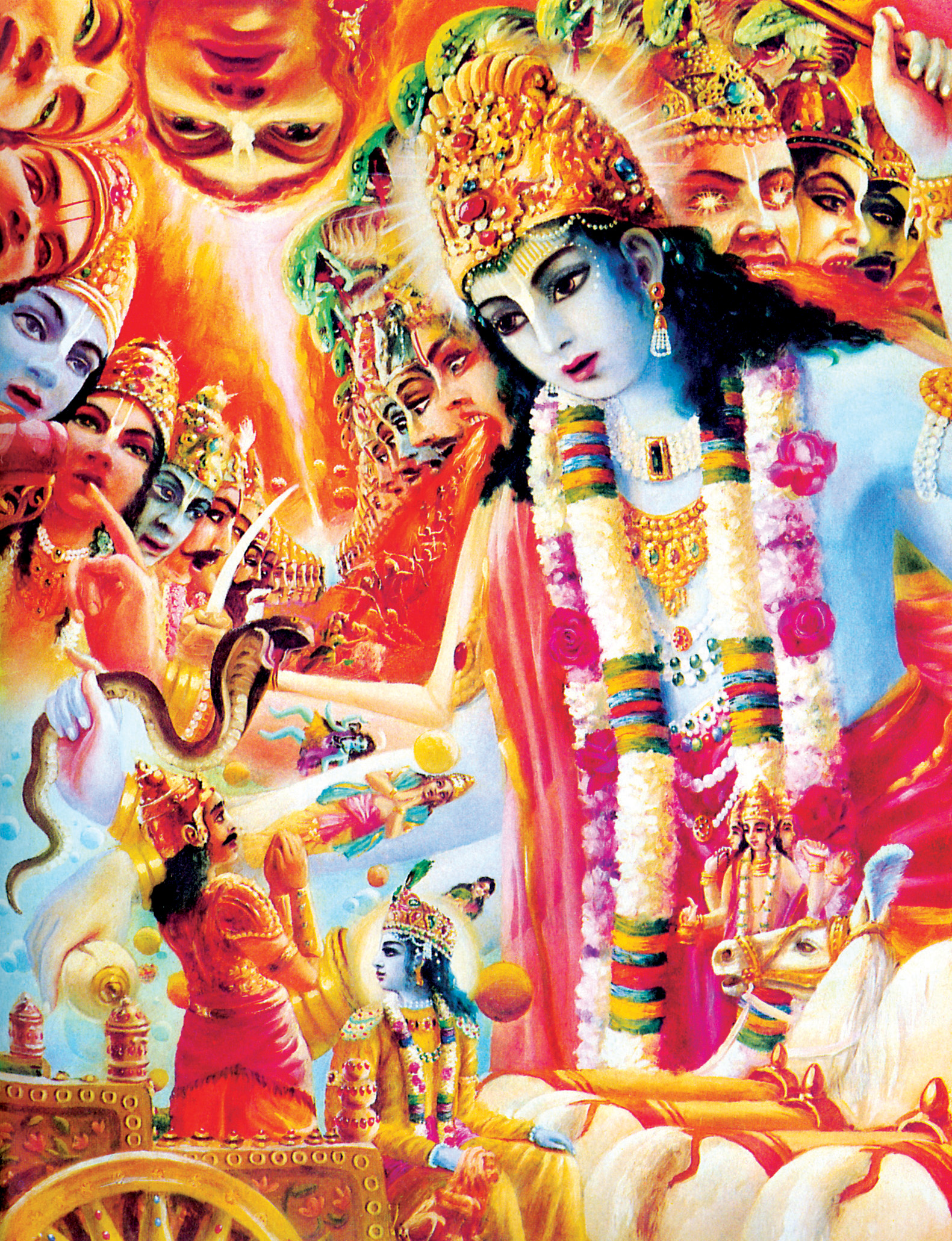
Opulence of the Supreme Lord

I have always liked this eleventh Chapter of Bhagavad-gita, entitled “The Universial Form”, because it explains a great deal of the relationship between Krishna and Arjuna, and of our relationship with God.

…As far as a devotee is concerned, he is not eager to see the universal form, but because Arjuna wanted to see Kṛṣṇa in this way, Kṛṣṇa reveals this form. This universal form is not possible to be seen by any ordinary man. Kṛṣṇa must give one the power to see it. (from purport Bg 10.5)

Devotees who are correctly situated in a transcendental relationship with Kṛṣṇa are attracted by loving features, not by a godless display of opulences. The playmates of Kṛṣṇa, the friends of Kṛṣṇa and the parents of Kṛṣṇa never want Kṛṣṇa to show His opulences. They are so immersed in pure love that they do not even know that Kṛṣṇa is the Supreme Personality of Godhead. In their loving exchange they forget that Kṛṣṇa is the Supreme Lord. In the Śrīmad-Bhāgavatam it is stated that the boys who play with Kṛṣṇa are all highly pious souls, and after many, many births they are able to play with Kṛṣṇa. Such boys do not know that Kṛṣṇa is the Supreme Personality of Godhead. They take Him as a personal friend. (from purport Bg 11.8)

Bhagavad-gita As It Is Original 1972 Edition

by His Divine Grace A. C. Bhaktivedanta Swami Prabhupada

The Universital Form

Chapter 11

I have in the past addressed You as “O Kṛṣṇa,” “O Yādava,” “O my friend,” without knowing Your glories. Please forgive whatever I may have done in madness or in love. I have dishonored You many times while relaxing or while lying on the same bed or eating together, sometimes alone and sometimes in front of many friends. Please excuse me for all my offenses. (Bg. 11.42)

PURPORT

Although Kṛṣṇa is manifested before Arjuna in His universal form, Arjuna remembers his friendly relationship with Kṛṣṇa and is therefore asking pardon and requesting Him to excuse him for the many informal gestures which arise out of friendship. He is admitting that formerly he did not know that Kṛṣṇa could assume such a universal form, although He explained it as his intimate friend. Arjuna did not know how many times he may have dishonored Him by addressing Him as “O my friend, O Kṛṣṇa, O Yādava,” etc., without acknowledging His opulence. But Kṛṣṇa is so kind and merciful that in spite of such opulence He played with Arjuna as a friend. Such is the transcendental loving reciprocation between the devotee and the Lord. The relationship between the living entity and Kṛṣṇa is fixed eternally; it cannot be forgotten, as we can see from the behavior of Arjuna. Although Arjuna has seen the opulence in the universal form, he could not forget his friendly relationship with Kṛṣṇa.

You are the Supreme Lord, to be worshiped by every living being. Thus I fall down to offer You my respects and ask Your mercy. Please tolerate the wrongs that I may have done to You and bear with me as a father with his son, or a friend with his friend, or a lover with his beloved. B(Bg 11.44)

Purport

Kṛṣṇa’s devotees relate to Kṛṣṇa in various relationships; one might treat Kṛṣṇa as a son, one might treat Kṛṣṇa as a husband, as a friend, as a master, etc. Kṛṣṇa and Arjuna are related in friendship. As the father tolerates, or the husband or master tolerates, so Kṛṣṇa tolerates.

Full chapter The Universal Form

When Lord Krishna Garlanded Prabhupada

When Lord Krishna Garlanded Prabhupada
Bahushiras Das Adhikary

The following narration is from the visionary Memories series of Shriman Siddhanta das Adhikary. It is the remembrance of Shriman Bahushiras das Adhikary given in DVD 44 and in vol. 3, p. 334 of the book Memories-Anecdotes of a Modern-Day Saint.

After Srila Prabhupada’s disappearance, [Patita Pavana das] asked if I’d like to assist Satswarupa’s Lilamrita project by interviewing people in India who had known Srila Prabhupada. One of them was Acharya Prabhakar Misra, Prabhupada’s first disciple. Acharya Prabhakar Misra was clean-cut, well-behaved and articulate. His demeanor impressed me. He held a MA and PhD and was a very cultured Sanskrit scholar and teacher. In Jhansi, Prabhupada had told Acharya Prabhakar. “I met you because I saw you in a dream and I knew that I was supposed to come here.” Prabhupada and he would do bhajan together. They’d hold Rathayatra festivals and they’d have program in villages in the area.

Acharya Prabhakar said that on Shri Krishna Janmashtami in 1954, he had to go to Delhi. When he returned to Jhansi, he took a little rest, woke up at 1:00 am and heard Srila Prabhupada ecstatically playing mridanga in the temple room. Prabhupada was chanting in total bliss. Acharya Prabhakar went upstairs and saw Srila Prabhupada bouncing around the temple room performing kirtan. Prabhupada was wearing a kadamba flower garland that went all the way down to his feet. Kadamba flowers are very rare in Jhansi and when they are available they are usually the size of a golf ball. But the ones Prabhupada was wearing were big, the size of tennis balls. And he said that the atmosphere right down to the atoms in the room was not material, aprakrita. The place was surcharged with the fragrance of the heavenly planets. Acharya Prabhakar wanted to ask Shrila Prabhupada, “Where did this garland come from? It is not available from the market.” But Srila Prabhupada would not answer. His Divine Grace just kept on performing kirtan, bouncing round the room and chanting. The next morning Acharya Prabhakar asked Srila Prabhupada, “Where did you get the garland, why did it have such a rich fragrance, and why were you feeling so blissful?”

Srila Prabhupada told him, “I was chanting to Krishna and feeling some love for Him. And He appeared and gave me this garland. I went to touch His feet and He disappeared. Because of that I was dancing around the temple room.” Srila Prabhupada was crying.

Acharya Prabhakar was very believable and I felt that what he told me was valid. He also said that sometimes Srila Prabhupada’s mood was to perform kirtan intensely. He would chant on and on and on for three days straight. We hear that sometimes he wouldn’t eat for long periods, especially near the end of his manifest lila, but remarkably in Jhansi, he was doing kirtan for a long period of time without eating or sleeping. And the result of his bhajan was that Krishna appeared. (Siddhanta das)

Creating the Post of Officiating Acarya’s

This initiation issue has divided much of the ISKCON society. Some devotees believe that Srila Prabhupada has always been, and will continue to be the Founder and Acarya for The Hare Krishna Movement (ISKCON), while others believe that he has moved on, leaving the present Iskcon gurus to accept new devotees as their disciples. This has created a rift in the society.

For me personality, Srila Prabhupada has accepted me as his disciple, and I have accepted him as my eternal Spiritual Master, so for me the issue is very clear. Srila Prabhupada has always been, and will continue to be my spiritual master and the Founder and Acarya of ISKCON.

But we are posting some of the History of ISKCON and the Initiation process for the benefit of others. May we all advance in our love for Krishna, and work together is the spirit of cooperation, to push on Sri Caitanya Mahaprabhu’s Sankirtan Movement. Hare Krishna! -V

…By 1973, Srila Prabhupada had trained his GBC secretaries to serve as officiating priests by asking them to (1) recommend candidates for initiation, (2) choose Sanskrit names for new initiates, (3) chant on new initiates’ japa beads, and (4) officiate at fire sacrifices.

…The July 9 ritvik system was already 80% implemented in those early years. When Srila Prabhupada visited us in 1975, he did no initiations. Of course the terms “officiating acharya” and “ritvik” were not given by Srila Prabhupada until May 1977, which I did not learn of until 1984. I am witness to how Srila Prabhupada progressively deputed the formalities of his initiations to temple presidents from at least 1970. I was given, and gave, Srila Prabhupada initiations via the system which was made official with the July 9, 1977 Order. (Nityananda das)

Full article

Continue reading →

The Pañca-tattva Mantra

Bhagavad-Gita-Original-Art-Pancha-Tattva

PANCA-TATTVA MAHA-MANTRA

(jaya) sri-krsna-caitanya prabhu nityananda

sri-advaita gadadhara srivasadi-gaura-bhakta-vrnda

“I offer my respectful obeisances unto Sri Caitanya Mahaprabhu, Lord Nityananda, Sri Advaita,
Gadadhara Pandit, Srivas Thakur, and all the devotees of Lord Caitanya.”

“

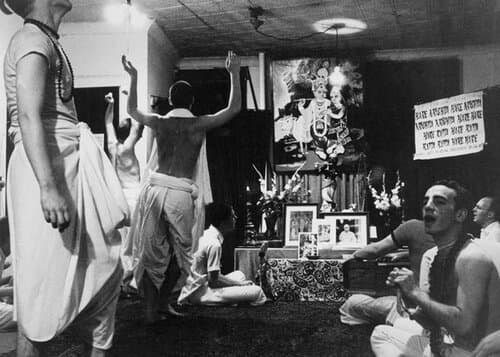
…There are ten offenses in the chanting of the Hare Kṛṣṇa mahā-mantra, but these are not considered in the chanting of the Pañca-tattva mantra, namely, śrī-kṛṣṇa-caitanya prabhu-nityānanda śrī-advaita gadādhara śrīvāsādi-gaura-bhakta-vṛnda. Śrī Caitanya Mahāprabhu is known as mahā-vadānyāvatāra, the most magnanimous incarnation, for He does not consider the offenses of the fallen souls. Thus to derive the full benefit of the chanting of the mahā-mantra (Hare Kṛṣṇa, Hare Kṛṣṇa, Kṛṣṇa Kṛṣṇa, Hare Hare Hare Rāma, Hare Rāma, Rāma Rāma, Hare Hare), we must first take shelter of Śrī Caitanya Mahāprabhu, learn the Pañca-tattva mahā-mantra, and then chant the Hare Kṛṣṇa mahā-mantra. That will be very effective.

Continue reading →

What is Mayavada Philosophy

My wife read me this the other day, from the purport to verse Madya-lila 7.17.145 in the Caitanya-caritmrta.

The youths who joined this movement were not very advanced as far as purity was concerned, nor were they very well educated in Vedic knowledge, but because they were not offenders, they could accept the importance of the Hare Kṛṣṇa movement.

…when we came to preach the Hare Krishna movement in the West. When we came to New York in 1965, we never expected that the Hare Kṛṣṇa mahā-mantra would be accepted in this country. Nonetheless, we invited people to our storefront to join in chanting the Hare Kṛṣṇa mantra, and the Lord’s holy name is so attractive that simply by coming to our storefront in New York, fortunate young people became Kṛṣṇa conscious. Although this mission was started with insignificant capital, it is now going nicely. The spreading of the Hare Kṛṣṇa mahā-mantra in the West has become successful because the young people were not offenders. The youths who joined this movement were not very advanced as far as purity was concerned, nor were they very well educated in Vedic knowledge, but because they were not offenders, they could accept the importance of the Hare Kṛṣṇa movement. We are now very happy to see that this movement is advancing more and more in the Western countries. We therefore conclude that the so-called mlecchas and yavanas of the Western countries are more purified than offensive Māyāvādīs or atheistic impersonalists. (from purport Madya-lila 7.17.145)

This sentence jumped out at me ‘ but because they were not offenders, they could accept the importance of the Hare Kṛṣṇa movement’, and I wanted to understand what was meant by offenders. And I realized that Srila Prabhupada was refering to the Mayavada or Mayavadi Philosphy.

Continue reading →

Four Kinds of Men

This morning I woke up thinking about these verses from the Bhagavad-gita. I was thinking ‘why would someone not be attracted to the All Attractive Personality of Godhead Sri Krishna’. So I went to the Bhagavad-gita to re-read what Srila Prabhupada had said about surrendering to Krishna.

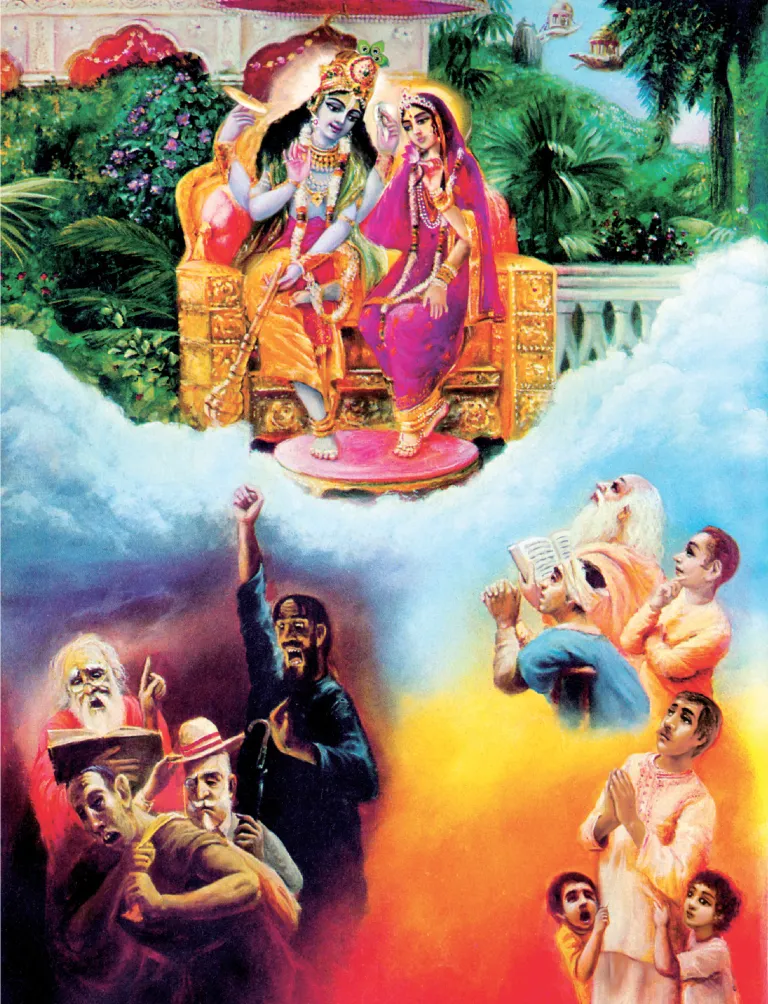
Those miscreants who are grossly foolish, lowest among mankind, whose knowledge is stolen by illusion, and who partake of the atheistic nature of demons, do not surrender unto Me. (Bg 7.15)

O best among the Bhāratas [Arjuna], four kinds of pious men render devotional service unto Me—the distressed, the desirer of wealth, the inquisitive, and he who is searching for knowledge of the Absolute. (Bg 7.16)

Śrī Yāmunācārya Albandru of South India said, “O my Lord! You are unknowable to persons involved with atheistic principles despite Your uncommon qualities, features, and activities and despite Your personality being confirmed by all the revealed scriptures in the quality of goodness, and despite Your being acknowledged by the famous authorities renowned for their depth of knowledge in the transcendental science and situated in the godly qualities.”

Therefore, (1) grossly foolish persons, (2) the lowest of mankind, (3) the deluded speculators, and (4) the professed atheists, as above mentioned, never surrender unto the lotus feet of the Personality of Godhead in spite of all scriptural and authoritative advice.

Continue reading →

Advent of Kali Yuga

Kali Yuga is the fourth and shortest Yuga in the cycle of four ages (Satya, Treta, Dvapara, and Kali), lasting 432,000 human years. Kali Yuga is said to last for 432,000 years, with approximately 5,000 years already passed. As stated in Bhagavad-gītā, the Lord descended to the earth for the protection of the faithful and annihilation of the impious, so after the Battle of Kurukṣetra and establishment of Mahārāja Yudhiṣṭhira, the mission of the Lord was complete. The Advent of Kali Yuga began after the departure of Lord Krishna.

Srimad Bhagavatam

Disappearance of Lord Krishna

by His Divine Grace A. C. Bhaktivedanta Swami Prabhupada

Canto 1, Chapter 14, Text 3

kālasya ca gatiṁ raudrāṁ
viparyastartu-dharmiṇaḥ
pāpīyasīṁ nṛṇāṁ vārtāṁ
krodha-lobhānṛtātmanām

kālasya — of eternal time; ca — also; gatim — direction; raudrām — fearful; viparyasta — reversed; ṛtu — seasonal; dharmiṇaḥ — regularities; pāpīyasīm — sinful; nṛṇām — of the human being; vārtām — means of livelihood; krodha — anger; lobha — greed; anṛta — falsehood; ātmanām — of the people.Translation

He saw that the direction of eternal time had changed, and this was very fearful. There were disruptions in the seasonal regularities. The people in general had become very greedy, angry and deceitful. And he saw that they were adopting foul means of livelihood.

Purport

When civilization is disconnected from the loving relation of the Supreme Personality of Godhead, symptoms like changes of seasonal regulations, foul means of livelihood, greed, anger and fraudulence become rampant. The change of seasonal regulations refers to one season’s atmosphere becoming manifest in another season — for example the rainy season’s being transferred to autumn, or the fructification of fruits and flowers from one season in another season. A godless man is invariably greedy, angry and fraudulent. Such a man can earn his livelihood by any means, black or white. During the reign of Mahārāja Yudhiṣṭhira, all the above symptoms were conspicuous by their absence. But Mahārāja Yudhiṣṭhira was astonished to experience even a slight change in the godly atmosphere of his kingdom, and at once he suspected the disappearance of the Lord. Foul means of livelihood implies deviation from one’s occupational duty. There are prescribed duties for everyone, such as the brāhmaṇa, kṣatriya, vaiśya and śūdra, but anyone who deviates from his prescribed duty and declares another’s duty to be his own is following a foul and improper duty. A man becomes too greedy for wealth and power when he has no higher objective in life and when he thinks that this earthly life of a few years is all in all. Ignorance is the cause for all these anomalies in human society, and to remove this ignorance, especially in this age of degradation, the powerful sun is there to distribute light in the shape of Śrīmad-Bhāgavatam.

Morning Walk with Srila Prabhupada

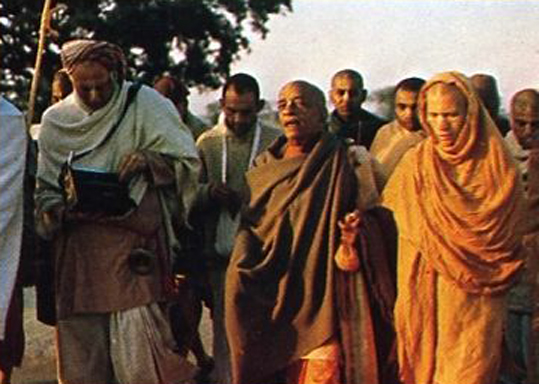
Śrīla Prabhupāda’s morning walks were significant events where he shared spiritual insights and teachings. During these walks, he often engaged with his disciples, discussing various philosophical topics and practical aspects of devotional life.

“Instead of contemplating what will happen to this world, you have got a short duration of life, say fifty, sixty years. You chant Hare Krsna and go back to home, back to Godhead. Don’t consider what will happen to this world. Nature will take care of it. You don’t puzzle your brain with these thoughts. You utilize whatever time you have got in your possession and go back to home, back to Godhead. You cannot check it. Best thing is that you mold your life and go back to home, back to Godhead. Because people will go on with their rascal civilization, natural consequences will be there. You better take advantage of whatever time you have got and become fully Krsna conscious and go back to home.”

[Srila Prabhupada, Morning Walk, February 21, 1975, Caracas]

Original Editions

Over the years, I have been all over the internet, looking at devotee web pages, and searching out Srila Prabhupada’s Original Books. There are many fine sites indeed, offering free downloads, and online reading, etc. But there is one Site in particular, I highly recommend. I happened upon it by chance one day when I typed in Prabhupada in the search bar.

The site is simply called Srila Prabhupada https://prabhupada.io/

They have one page I am very encouraged to see, when you click on the category “Library”, Srila Prabhupada’s Original books come up. Every word as Prabhupāda published it — the books exactly as they went to the printer in his own lifetime.

Original Editions https://prabhupada.io/books