Today marks the Appearance day of Sri Caitanya Mahaprabhu. We honor it with a full day fast until Moonrise, followed by a nice vegetarian feast. Todays post, in honor of the Lords appearance, are the eight verses Lord Caitanya left us, entitled Sri Sri Siksastaka.
Śrī Śrī Śikṣāṣṭaka Eight Instructions Lord Śrī Caitanya Mahāprabhu
Lord Caitanya Mahāprabhu instructed His disciples to write books on the science of Kṛṣṇa, a task which His followers have continued to carry out down to the present day. The elaborations and expositions on the philosophy taught by Lord Caitanya are, in fact, the most voluminous, exacting, and consistent, due to the system of disciplic succession. Although Lord Caitanya was widely renowned as a scholar in His youth, He left only eight verses, called Śikṣāṣṭaka. These eight verses clearly reveal His mission and precepts. These supremely valuable prayers are translated herein.
1) Glory to the śrī-kṛṣṇa-saṅkīrtana, which cleanses the heart of all the dust accumulated for years and extinguishes the fire of conditional life, of repeated birth and death. This saṅkīrtana movement is the prime benediction for humanity at large because it spreads the rays of the benediction moon. It is the life of all transcendental knowledge. It increases the ocean of transcendental bliss, and it enables us to fully taste the nectar for which we are always anxious.
This is a song that is sung daily, usually before Srimad Bhagavatam class, in all of the Hare Krishna Temples. It is a very beautiful song.
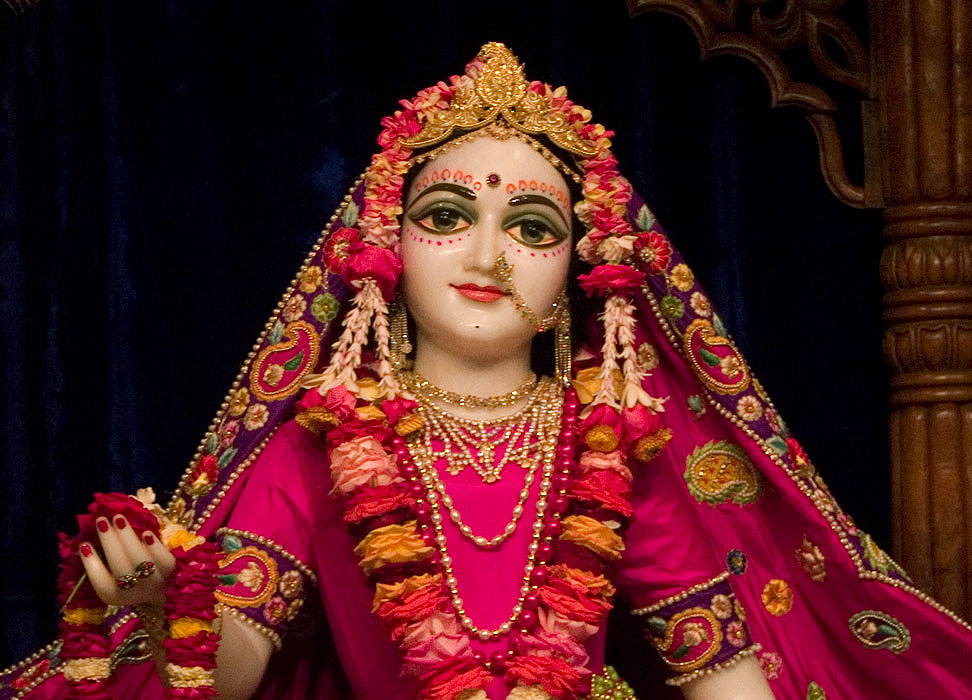
Srila Prabhupada said that this song is “a picture of Vrndavana.” Everything is there–Srimati Radharani, Vrndavana, Govardhana, Yasoda, and all the cowherd boys.
jaya–all glories to: rādhā-mādhava–Rādhā and the Lord of sweetness; kuñja-bihārī–He who enjoys loving pastimes in the groves of Vṛndāvana; gopī-jana-vallabha–the lover of the cowherd maidens of Vraja; giri-vara-dhārī–the holder of the great hill named Govardhana;
Krsna is the lover of Radha. He displays many amorous pastimes in the groves of Vrndavana, He is the lover of the cowherd maidens of Vraja, and the holder of the great hill named Govardhana.
yaśodā-nandana–the beloved son of mother Yaśodā; vraja-jana-rañjana–the delighter of the inhabitants of Vraja; yāmuna-tīra-vana-cārī–who wanders in the forests along the banks of the river Yamunā
He is the beloved son of mother Yasoda, the delighter of the inhabitants of Vraja, and He wanders in the forests along the banks of the River Yamuna!
Purport to Jaya Rādhā-Mādhava New York, July 20, 1971
Today we celebrate the Appearance of Srila Bhaktisiddhanta Saraswati Thakura, the son of Srila Bhaktivinoda Thakura, and Spiritual Master of our Srila Prabhupada. We will honor it with a half day fast, rememberances and readings.
From the Library of Gargamuni das
”My Guru Maharaj” (Part-7)
Srila A.C Bhaktivedanta Swami Prabhupada: Whatever little success is in our movement, the cause is I have not tried to cheat. Honestly, what I knew, I heard it from Guru Maharaja and scripture, I took it. There was no cheating. (Room Conversation — April 16, 1977, Bombay)
Srila Prabhupada: My Guru Maharaja said that Instead of earning livelihood by showing the Deity in the temple, it is better to take the profession of a sweeper in the street and live honestly. He said like that. The sweeper, he is working hard, toiling, and getting some money and living. This is honest living. (Room Conversation — September 21, 1973, Bombay)
Srila Prabhupada: My Guru Maharaja used to use to place so many examples, [laughs] I do not know all of them. No, there is a book, Nyaya-sastra, logic. You’ll find all these things.(Morning Walk — July 5, 1976, Washington, D.C)
Srila Prabhupada: My Guru Maharaja used to say,I think I have explained many times,that “Don’t try to see God. Do in such a way that God will see you.” Similarly, don’t try to advise God, but follow the advice of God. That is our way. (Morning Walk — January 22, 1976, Mayapur)
Srila Prabhupda: That is the world. Therefore the whole world is the society of cheater and cheated. That is the version of my Guru Maharaja. The whole so-called human society means a bunch of cheaters and cheated. That’s all. So don’t be cheater; don’t be cheated. That is intelligence. ( Morning Walk — March 14, 1976, Mayapur)
Srila Prabhupada: That we have been taught by our Guru Maharaja, twenty-four hours engagement with Krsna. So maya has no scope to enter in our mind. She always remains aloof: “Oh, here is fire. I cannot touch.” (Room Conversation — May 13, 1969, Columbus OH)
Srila Prabhupada wrote and published over 80 volumes of spiritual literature which he considered to be his most important contribution. Despite the heavy demands of establishing and managing a worldwide movement, Srila Prabhupada never failed to rise early in the morning to perform his beloved writing work. He applied great devotion and care in translating the ancient Vedic literatures into English from the original Sanskrit and Bengali languages. He would then dictate his famous “Bhaktivedanta Purports,” further explaining the meaning of each verse and its relevance to the modern age. Prabhupada’s books are highly acclaimed by scholars and students alike (see reviews below). They have been translated into more than 60 languages and have been sold in the hundreds of millions. The PrabhupadaConnection encourages everyone to take advantage of these timeless literatures which are full of spiritual knowledge and potency. . Books by His Divine Grace A.C. Bhaktivedanta Swami Prabhupada . Bhagavad-gita As It Is Srimad-Bhagavatam, cantos 1-10, (29 vols.) Sri Caitanya-caritamrta (17 vols.) Teachings of Lord Caitanya The Nectar of Devotion Sri Isopanisad Easy Journey to Other Planets Krsna Consciousness: The Topmost Yoga System Krsna, the Supreme Personality of Godhead (3 vols.) Perfect Questions, Perfect Answers Dialectical Spiritualism—A Vedic View of Western Philosophy Teachings of Lord Kapila, the Son of Devahuti Transcendental Teachings of Prahlad Maharaja Teachings of Queen Kunti Krsna, the Reservoir of Pleasure The Science of Self-Realization The Path of Perfection Life Comes From Life The Perfection of Yoga Beyond Birth and Death On the Way to Krsna Raja-vidya: The King of Knowledge Elevation to Krsna Consciousness Krsna Consciousness: The Matchless Gift Back to Godhead magazine (founder) Scholars Review Srila Prabhupada’s Books
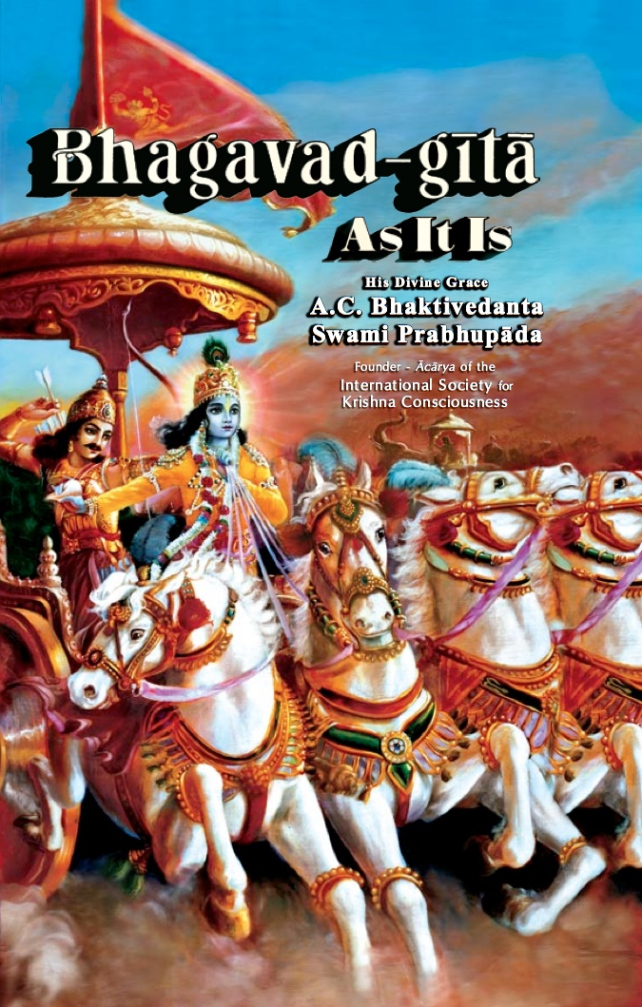
Actually I remember being very excited years ago when I first created this page, as it made available Srila Prabhupada’s original Bhagavad-gita “As It Is” 1972 edition, with a very simple user friendly format, and all the original pictures. I never really promoted it, other than as a link from my site The Hare Krishna Movement. But in retrospect, it has met with good success as it has reached over one million visitors. I think it might possibly have some useful value for today’s cell phone, and tablet users.
We all have our favorite quotes and slokas from the pages of Srila Prabhupada’s books. One of mine is the following:
“My dear King, although Kali-yuga is full of faults, there is still one good quality about this age. It is that simply by chanting the Hare Kṛṣṇa mahā-mantra, one can become free from material bondage and be promoted to the transcendental kingdom.” (Bhāg. 12.3.51)
Srila Prabhupada quotes this partictular verse from the Bhagavatam many times in his lectures, conversations, books etc., for instance:
“In the sastra it is said this Kali-yuga is full of faults, so many faults. It is the ocean of faults. But there is a very nice thing, asti hy eko mahan gunah, a very great quality. What is that? Kirtanad eva krsnasya mukta-sangah param vrajet [SB 12.3.51]. If you simply chant Hare Krishna mantra, then you become perfect. Is it very difficult? Chant Hare Krishna and you become perfect. But we are so unfortunate, we are not even prepared to chant. This is our position. So you have to make little determination that ‘I shall chant henceforward Hare Krishna mantra.’ Then everything is all right.”
So Kṛṣṇa consciousness movement is very difficult to understand, but by the grace of Kṛṣṇa, it has been made very easy. Easy. That is stated in the Śrīmad-Bhāgavatam. Kaler doṣa-nidhe rājann asti hy eko mahān guṇaḥ. It was explained by Śukadeva Gosvāmī to Parīkṣit Mahārāja. He described the faults of the Kali-yuga, but he encouraged by one verse. “My dear king, there is one very nice opportunity in this Kali-yuga.” Kaler doṣa-nidhe. Doṣa-nidhi: “It is the ocean of faults, but there is one very nice gain in this Kali-yuga.” What is that? Kīrtanād eva kṛṣṇasya mukta-saṅgaḥ paraṁ vrajet: [SB 12.3.51] “Simply by chanting Hare Kṛṣṇa mantra one can become free from all the troubles of this yuga, Kali-yuga,” and mukta-saṅga, “and he becomes liberated, and he goes back to home, back to Godhead.” So take it very seriously and make your life perfect. (Lectures : Bhagavad-gita 7.3 — Nairobi, October 29, 1975)
So in this Kali-yuga people are degrading, and the supply also will be reduced. There will be no supply of milk, there will be no supply of sugar. That is stated in the Śrīmad-Bhāgavatam. There will be no supply of rice, no supply of wheat. Now you can get black market, white market, but time is coming when there will be no supply, completely. You will be forced to eat this beef. Now it is opening, beef shop, big, big beef shop. This time has already come, gradually, and it will be increasing. Unless you take to Kṛṣṇa consciousness. Kīrtanād eva kṛṣṇasya mukta-saṅgaḥ paraṁ vrajet [SB 12.3.51]. Kaler doṣa-nidhe rājann asti hy eko mahān guṇaḥ. This Kali-yuga is suffering. So you cannot get comfortable life in this Kali-yuga being godless. Because Kali-yuga means godless. Mandāḥ sumanda-matayo manda-bhāgyā hy upadrutāḥ [SB 1.1.10]. (Lectures : Bhagavad-gita 13.23 Bombay, October 22, 1973 )
Prabhupāda: Oh, yes, because this is a special advantage for the people in this age, that if he chants this Hare Kṛṣṇa mantra without any offense, purely, then… There are three stages of chanting this Hare Kṛṣṇa mantra. In the beginning there are full of offenses. Then it is almost offenseless. And then, when it is pure, that is perfectional stage. So by chanting, if you practice chanting, even though in the beginning it is full of offenses, but if you continue chanting… Therefore we say that “You must chant so many times.” So even there are offenses, by chanting, chanting, chanting, chanting, he will be purified. Ceto-darpaṇa-mārjanam [Cc. Antya 20.12]. So therefore, in this age we must stick to this process of chanting. That will make us perfect. If not immediately, it will do, certainly. That is special advantage for the men of this age. Kaler doṣa-nidhe rājann asti hy eko mahān guṇaḥ. Mahān guṇaḥ. It is a great advantage. What is that? Kīrtanād eva kṛṣṇasya: [SB 12.3.51] “Simply by chanting Lord Kṛṣṇa’s name,” mukta-saṅga, ‘he becomes free from all contamination and he becomes eligible to be promoted to the spiritual kingdom.” That is special advantage of this age. Therefore we are advising, we are preaching, that “You chant this mantra. In any condition of life, begin chanting. You will be benefited.” Yes. (Lectures : Srimad-Bhagavatam 6.1.41-42 — Surat, December 23, 1970)
Nāma is Kṛṣṇa. So He has already come. He’s… Ceto-darpaṇa-mārjanaṁ bhava-mahā-dāvāgni [Cc. Antya 20.12]. If you simply take harer nāma harer nāma… [Cc. Ādi 17.21]. Kīrtanād eva kṛṣṇasya mukta-saṅgaḥ paraṁ vrajet [SB 12.3.51]. This is the verdict of Bhāgavata. Kaler doṣa-nidhe rājann asti hy eko mahān guṇaḥ. We have got a special concession in this Kali-yuga. We cannot execute all the instruction in the Vedas. We are fallen down. But if we chant Hare Kṛṣṇa mahā-mantra-kīrtanād eva kṛṣṇasya mukta-saṅgaḥ paraṁ vrajet—he becomes liberated from all the faults of this Kali-yuga and paraṁ vrajet, goes back home, back to Godhead. So Kṛṣṇa is already there. Harer nāma harer nāma harer nāmaiva kevalam, kalau nāsty eva nāsty eva nāsty eva [Cc. Ādi 17.21]. This is Caitanya Mahāprabhu’s… Chant Hare Kṛṣṇa. Wherever you are staying, it doesn’t matter. Sthāne sthitāḥ śruti-gatāṁ tanu-vāṅ-manobhiḥ. There is very simple formula. You can become liberated simply by chanting. And if you think that you are very learned philosopher, read all these books. Two ways there are. Thing is very simple. Even a boy can chant Hare Kṛṣṇa. (1977 Conversations : May, 1977 : Evening Darsana — May 12, 1977, Hrishikesh)
As we approach Christmas Day, I am often reminded of the reason people celebrate this Holy day. In these days especially, we find there is a need for more kindness and compassion, and Jesus set a very good example of these qualities.
The Śrīmad-Bhāgavatam states that any bona fide preacher of God consciousness must have the qualities of titikṣā (tolerance) and karuṇā (compassion). In the character of Lord Jesus Christ we find both these qualities. He was so tolerant that even while he was being crucified, he didn’t condemn anyone. And he was so compassionate that he prayed to God to forgive the very persons who were trying to kill him. (Of course, they could not actually kill him. But they were thinking that he could be killed, so they were committing a great offense.) As Christ was being crucified he prayed, “Father, forgive them. They know not what they are doing.”
…Of course, the message that Christ preached was just according to his particular time, place, and country, and just suited for a particular group of people. But certainly he is the representative of God. Therefore we adore Lord Jesus Christ and offer our obeisances to him. Once, in Melbourne, a group of Christian ministers came to visit me. They asked, “What is your idea of Jesus Christ?” I told them, “He is our guru. He is preaching God consciousness, so he is our spiritual master.” The ministers very much appreciated that.
Actually, anyone who is preaching God’s glories must be accepted as a guru. Jesus Christ is one such great personality. We should not think of him as an ordinary human being. The scriptures say that anyone who considers the spiritual master to be an ordinary man has a hellish mentality. If Jesus Christ were an ordinary man, then he could not have delivered God consciousness. (Science of Self Realization, Chapter 4, “Understanding Krsna and Christ)
Here is another word for your vaisnava vocabulary; Acaryopasanam.
In Bhagavad-gita, Thirteenth Chapter, it is clearly stated that one should execute devotional service and advance on the path of spiritual knowledge by accepting the acarya.Ācāryopāsanam: one should worship an acarya, a spiritual master who knows things as they are. The spiritual master must be in the disciplic succession from Krsna. (from purport SB 3.29.17)
We can understand from Srila Prabhupada, that there are huge gaps in the disciplic succession, but we need to follow the prominent Acarya.
“So these gaps do not hamper from understanding the parampara system. We have to pick up the Prominent Acarya, and follow from him.” (letter to Dayananda April12,1968)
Back when I was a new aspiring devotee, and was hearing and learning the stories from the Srimad-Bhagavatam for the very first time, the story of King Indra cursed to take birth as a hog, was without a doubt one of my favorites. I first read it in the Raja-Vidya, then heard it repeated so many times in Srimad-Bhagavatam class’s, and it became more relishable with each hearing.
…At one time, Indra, the king of heaven, committed an offense at the feet of his spiritual master, and his spiritual master cursed him to take the birth of a hog. Thus the throne of the heavenly kingdom became empty as Indra went to earth to become a hog.
Seeing the situation, Brahma came to earth and addressed the hog: “My dear sir, you have become a hog on this planet earth. I have come to deliver you. Come with me at once.” But the hog replied:. “Oh I cannot go with you. I have so many responsibilities—my children, wife and this nice hog society.”
Even though Brahma promised to take him back to heaven, Indra, in the form of a hog, refused. This is called forgetfulness. Similarly, Lord Sri Krishna comes and says to us, “What are you doing in this material world? Sarva-dharman parityajya mam ekam saranam vraja [Bg. 18.66].
Come to Me, and I’ll give you all protection.” But we say, “I don’t believe You Sir. I have more important business here.” This is the position of the conditioned soul—forgetfulness. This forgetfulness is quickly dissipated by following in the path of disciplic succession.
We become so attached to our so-called material enjoyment, but what is this enjoyment? Our situation is not always so good, and there is birth, death, disease, and old age, but still we are attached; this seems to be our situation.