I envy no one, nor am I partial to anyone. I am equal to all. But whoever renders service unto Me in devotion is a friend, is in Me, and I am also a friend to him. (Bg 9.29)
Even if one commits the most abominable actions, if he is engaged in devotional service, he is to be considered saintly because he is properly situated. (Bg 9.30)
When Lord Krishna Garlanded Prabhupada Bahushiras Das Adhikary
The following narration is from the visionary Memories series of Shriman Siddhanta das Adhikary. It is the remembrance of Shriman Bahushiras das Adhikary given in DVD 44 and in vol. 3, p. 334 of the book Memories-Anecdotes of a Modern-Day Saint.
After Srila Prabhupada’s disappearance, [Patita Pavana das] asked if I’d like to assist Satswarupa’s Lilamrita project by interviewing people in India who had known Srila Prabhupada. One of them was Acharya Prabhakar Misra, Prabhupada’s first disciple. Acharya Prabhakar Misra was clean-cut, well-behaved and articulate. His demeanor impressed me. He held a MA and PhD and was a very cultured Sanskrit scholar and teacher. In Jhansi, Prabhupada had told Acharya Prabhakar. “I met you because I saw you in a dream and I knew that I was supposed to come here.” Prabhupada and he would do bhajan together. They’d hold Rathayatra festivals and they’d have program in villages in the area.
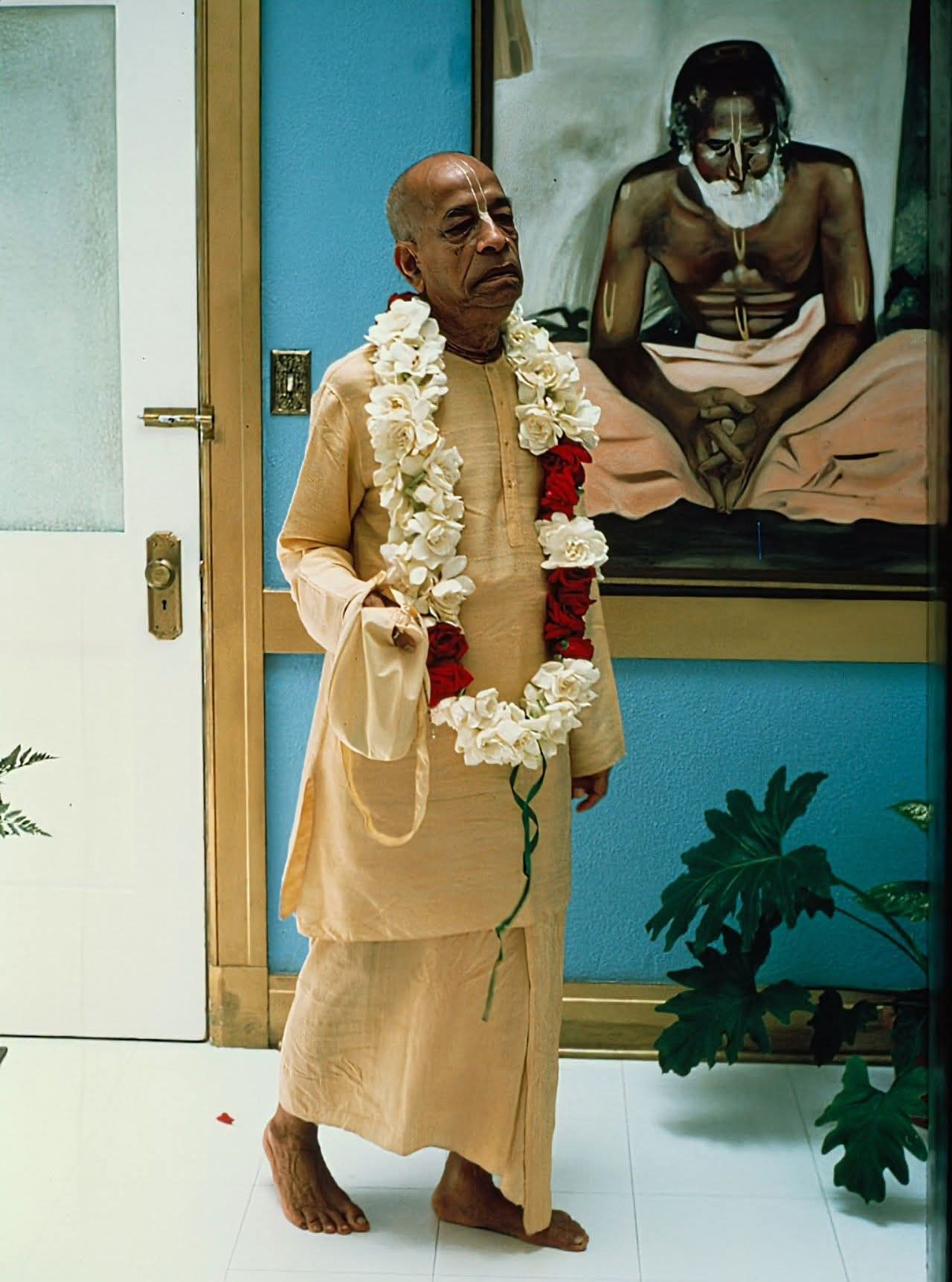
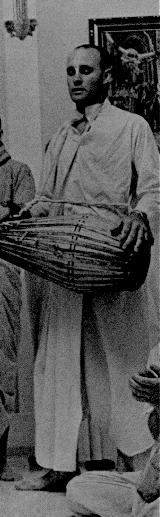
Acharya Prabhakar said that on Shri Krishna Janmashtami in 1954, he had to go to Delhi. When he returned to Jhansi, he took a little rest, woke up at 1:00 am and heard Srila Prabhupada ecstatically playing mridanga in the temple room. Prabhupada was chanting in total bliss. Acharya Prabhakar went upstairs and saw Srila Prabhupada bouncing around the temple room performing kirtan. Prabhupada was wearing a kadamba flower garland that went all the way down to his feet. Kadamba flowers are very rare in Jhansi and when they are available they are usually the size of a golf ball. But the ones Prabhupada was wearing were big, the size of tennis balls. And he said that the atmosphere right down to the atoms in the room was not material, aprakrita. The place was surcharged with the fragrance of the heavenly planets. Acharya Prabhakar wanted to ask Shrila Prabhupada, “Where did this garland come from? It is not available from the market.” But Srila Prabhupada would not answer. His Divine Grace just kept on performing kirtan, bouncing round the room and chanting. The next morning Acharya Prabhakar asked Srila Prabhupada, “Where did you get the garland, why did it have such a rich fragrance, and why were you feeling so blissful?”
Srila Prabhupada told him, “I was chanting to Krishna and feeling some love for Him. And He appeared and gave me this garland. I went to touch His feet and He disappeared. Because of that I was dancing around the temple room.” Srila Prabhupada was crying.
Acharya Prabhakar was very believable and I felt that what he told me was valid. He also said that sometimes Srila Prabhupada’s mood was to perform kirtan intensely. He would chant on and on and on for three days straight. We hear that sometimes he wouldn’t eat for long periods, especially near the end of his manifest lila, but remarkably in Jhansi, he was doing kirtan for a long period of time without eating or sleeping. And the result of his bhajan was that Krishna appeared. (Siddhanta das)
This morning I was reading from the Srimad Bhagavatam, First Canto, Chapter 7, entitled “The Son of Drona Punished”. This chapter has always intrigued me, because although the Srimad Bhagavatam was compiled by Srila Vyasedeva five thousand years ago, there is mention of the ultimate weapon, the brahmāstra [nuclear weapon] being used. We think that Atomic energy or Nuclear energy is some modern technological advancement, but actually this knowledge has been around since the time that Srimad Bhagavatam was first spoken, many thousands of years ago.
…The brahmāstra is similar to the modern nuclear weapon manipulated by atomic energy. The atomic energy works wholly on total combustibility, and so the brahmāstra also acts. It creates an intolerable heat similar to atomic radiation, but the difference is that the atomic bomb is a gross type of nuclear weapon, whereas the brahmāstra is a subtle type of weapon produced by chanting hymns. It is a different science, and in the days gone by such science was cultivated in the land of Bhārata-varṣa. The subtle science of chanting hymns is also material, but it has yet to be known by the modern material scientists. Subtle material science is not spiritual, but it has a direct relationship with the spiritual method, which is still subtler. A chanter of hymns knew how to apply the weapon as well as how to retract it. That was perfect knowledge. (from purport to SB 1.7.28)
…The theory that the modern atomic bomb explosions can annihilate the world is childish imagination. First of all, the atomic energy is not powerful enough to destroy the world. And secondly, ultimately it all rests on the supreme will of the Supreme Lord because without His will or sanction nothing can be built up or destroyed. It is foolish also to think that natural laws are ultimately powerful. Material nature’s law works under the direction of the Lord, as confirmed in the Bhagavad-gītā. The Lord says there that natural laws work under His supervision. The world can be destroyed only by the will of the Lord and not by the whims of tiny politicians. Lord Śrī Kṛṣṇa desired that the weapons released by both Drauṇi and Arjuna be withdrawn, and it was carried out by Arjuna at once. Similarly, there are many agents of the all-powerful Lord, and by His will only can one execute what He desires. (from purport to 1.7.32)
The story of Ajamila, is one most of us remember, because at the time of his death he chanted the Holy Name of the Lord, and was saved. Actually, he was thinking of his son whose name was Narayana (another name of Krishna), but because he chanted one of the Lords many names, he was saved from the Yamadutas. That is the power of the Holy Name.
Ajāmila has already atoned for all his sinful actions. Indeed, he has atoned not only for sins performed in one life but for those performed in millions of lives, for in a helpless condition he chanted the holy name of Nārāyaṇa. Even though he did not chant purely, he chanted without offense, and therefore he is now pure and eligible for liberation. (SB 6.2.7)
Purport
The Yamadūtas had considered only the external situation of Ajāmila. Since he was extremely sinful throughout his life, they thought he should be taken to Yamarāja and did not know that he had become free from the reactions of all his sins. The Viṣṇudūtas therefore instructed that because he had chanted the four syllables of the name Nārāyaṇa at the time of his death, he was freed from all sinful reactions. In this regard Śrīla Viśvanātha Cakravartī Ṭhākura quotes the following verses from the smṛti-śāstra:
nāmno hi yāvatī śaktiḥ pāpa-nirharaṇe hareḥ tāvat kartuṁ na śaknoti pātakaṁ pātakī naraḥ
“Simply by chanting one holy name of Hari, a sinful man can counteract the reactions to more sins than he is able to commit.” (Bṛhad-viṣṇu Purāṇa)
“If one chants the holy name of the Lord, even in a helpless condition or without desiring to do so, all the reactions of his sinful life depart, just as when a lion roars, all the small animals flee in fear.” (Garuḍa Purāṇa)
sakṛd uccāritaṁ yena harir ity akṣara-dvayam baddha-parikaras tena mokṣāya gamanaṁ prati
“By once chanting the holy name of the Lord, which consists of the two syllables ha-ri, one guarantees his path to liberation.” (Skanda Purāṇa)
These are some of the reasons why the Viṣṇudūtas objected to the Yamadūtas’ taking Ajāmila to the court of Yamarāja.
“I offer my respectful obeisances unto Sri Caitanya Mahaprabhu, Lord Nityananda, Sri Advaita, Gadadhara Pandit, Srivas Thakur, and all the devotees of Lord Caitanya.”
“
…There are ten offenses in the chanting of the Hare Kṛṣṇa mahā-mantra, but these are not considered in the chanting of the Pañca-tattva mantra, namely, śrī-kṛṣṇa-caitanya prabhu-nityānanda śrī-advaita gadādhara śrīvāsādi-gaura-bhakta-vṛnda. Śrī Caitanya Mahāprabhu is known as mahā-vadānyāvatāra, the most magnanimous incarnation, for He does not consider the offenses of the fallen souls. Thus to derive the full benefit of the chanting of the mahā-mantra (Hare Kṛṣṇa, Hare Kṛṣṇa, Kṛṣṇa Kṛṣṇa, Hare Hare Hare Rāma, Hare Rāma, Rāma Rāma, Hare Hare), we must first take shelter of Śrī Caitanya Mahāprabhu, learn the Pañca-tattva mahā-mantra, and then chant the Hare Kṛṣṇa mahā-mantra. That will be very effective.
My wife read me this the other day, from the purport to verse Madya-lila 7.17.145 in the Caitanya-caritmrta.
The youths who joined this movement were not very advanced as far as purity was concerned, nor were they very well educated in Vedic knowledge, but because they were not offenders, they could accept the importance of the Hare Kṛṣṇa movement.
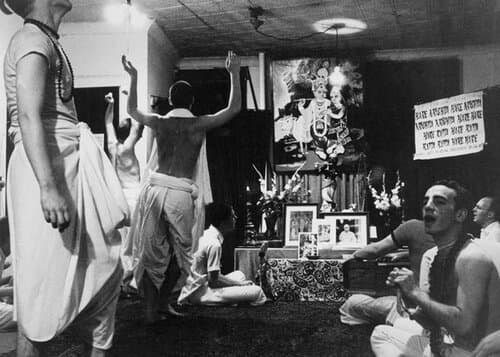
…when we came to preach the Hare Krishna movement in the West. When we came to New York in 1965, we never expected that the Hare Kṛṣṇa mahā-mantra would be accepted in this country. Nonetheless, we invited people to our storefront to join in chanting the Hare Kṛṣṇa mantra, and the Lord’s holy name is so attractive that simply by coming to our storefront in New York, fortunate young people became Kṛṣṇa conscious. Although this mission was started with insignificant capital, it is now going nicely. The spreading of the Hare Kṛṣṇa mahā-mantra in the West has become successful because the young people were not offenders. The youths who joined this movement were not very advanced as far as purity was concerned, nor were they very well educated in Vedic knowledge, but because they were not offenders, they could accept the importance of the Hare Kṛṣṇa movement. We are now very happy to see that this movement is advancing more and more in the Western countries. We therefore conclude that the so-called mlecchas and yavanas of the Western countries are more purified than offensive Māyāvādīs or atheistic impersonalists. (from purport Madya-lila 7.17.145)
This sentence jumped out at me ‘ but because they were not offenders, they could accept the importance of the Hare Kṛṣṇa movement’, and I wanted to understand what was meant byoffenders. And I realized that Srila Prabhupada was refering to the Mayavada or Mayavadi Philosphy.
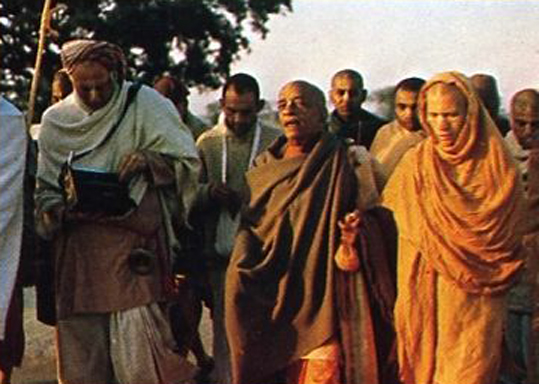
Śrīla Prabhupāda’s morning walks were significant events where he shared spiritual insights and teachings. During these walks, he often engaged with his disciples, discussing various philosophical topics and practical aspects of devotional life.
“Instead of contemplating what will happen to this world, you have got a short duration of life, say fifty, sixty years. You chant Hare Krsna and go back to home, back to Godhead. Don’t consider what will happen to this world. Nature will take care of it. You don’t puzzle your brain with these thoughts. You utilize whatever time you have got in your possession and go back to home, back to Godhead. You cannot check it. Best thing is that you mold your life and go back to home, back to Godhead. Because people will go on with their rascal civilization, natural consequences will be there. You better take advantage of whatever time you have got and become fully Krsna conscious and go back to home.”
[Srila Prabhupada, Morning Walk, February 21, 1975, Caracas]
\Today is the Apperancee Day of Our Beloved Spiritual Master, His Divine Grace A.C. Bhaktivedanta Swami Prabhupada. The Founder-Acarya of the International Society for Krishna Consciousness. We offer our profound gratitude and respectful obeisances. All Glories to Srila Prabhupada!
Vyasa-Puja: The Most Blessed Event
Dear Srila Prabhupada
So today, on this Most Blessed day, Your Appearance day celebration, Please accept my humble obeisances again and again, and kindly forgive my offenses.
On this auspicious day I have come with this offering just to worship you. On this day, and every day, I am filled with a sense of gratitude and wonder. I cannot even imagine where my life would be today, if you had not appeared and blessed us all with your divine mercy.
The fact that you have always resided in my heart, and have been my most constant friend and ever well-wisher, even without your physical presence, proves our eternal relationship with you. So many friends and family have come and gone, but you Srila Prabhupada, have remained in my life as the one constant in my life, I could always turn to.
You are present in your vani; your books and instructions. You are present still in your pictures and murti’s. You live in the hearts of your sincere devotees. You have touched us all so deeply; we cannot help but remember you. Srila Prabhupa, I am most unworthy to have received your mercy, and because of knowing my insignificance, it has caused me to be even more grateful and appreciative of your blessings.
“Indeed, I am just like a dwarf who wants to capture the moon. Although I am completely unfit, a desire to receive Your mercy is awakening within my mind.”
In writing this homage, I am reminded of a dream I had recently. In my dream you were reclining on your right side, propped up on your elbow and I was kneeling down in front of you. I said “Srila Prabhupada, my Krsna Consciousness is still very child-like”. Your face lit up and your Lotus eyes became very large.“Oh!” You said. “Sometimes when I see your picture, I began to cry” I replied. You leaned forward and very gravely but kindly said, “Yes, it is alright to have love and affection for your Spiritual Master”. I awoke from the dream and offered my obeisances thinking of your extraordinary magnanimity and kindness and your ability to ease our suffering and allow us to love you even more.
So on this Most Blessed day, Your Appearance day celebration, Please accept my humble obeisance again and again, kindly forgive my offenses, and continue to guide me as my captain with your books as maps, to steer me through the rough waters of this dangerous age of Kali
Begging to remain your eternal servant Vyasasan das
Remembering Jayananda by Vyasasan das __________________
There are some things about becoming a devotee I will never forget, for instance; receiving my first book, relishing my first plate of prasadam, seeing the deities in the temple for the first time, meeting Srila Prabhupada, Visnujhana Swami and Jayananda das bramachari.
The first time I meet Jayananda, was in 1975 in San Diego. I had been traveling with the RDTSKP for the last few months, since I joined. I was very much enjoying being a devotee, and traveling and putting on festivals, distributing prasadam, books and the Holy Name. By this time I had meet a number of Sannyasis; including Tamal Krsna Goswami, Gurudas Swami, Tripuari Swami, Vishnujana Swami, etc. and was very impressed by their character, and position.
One morning after Bhagavatam class we were all sitting down on the floor taking our breakfast. I was looking over at all the assembled sannyasis; there must have been seven of them eating together. They all had on nice orange clothing, and were eating off beautiful silver plates, and I was thinking, “Ya, that’s what I want. I want to be a Hare Krishna Sannyasa. Devotees will offer me respectful obeisances when they see me, and I will always get the best accommodations and best prasadam”. So I was thinking like this… when in walks in this guy in a greasy hooded sweatshirt, ripped doti, hands and face covered with dirt and grease, (it turns out he just changed the oil in 6 sankirtan vans), and he walks over to the prasadam table and starts filling a plate.
So I ask the devotee sitting next to me, “Who is that guy, is he supposed to be here?” I thought it was some bum wearing a dhoti. But the devotee replied; “Oh, that’s Jayananda Prabhu, he’s a really advanced devotee”. Well I was looking at Jayananda who was eagerly feasting on the morning prasadam, and I was looking over at the sannyasis who were carefully moving the prasadam around the silver plates, and I just wasn’t that sure?
As fate would have it, right after we finished our breakfast, I was told that I would be traveling with Jayananda. So with my head in hand I slowly went over to the sankirtan van he would be driving and opened the passenger side door. He greeted me with a huge radiant smile and an ear shattering “Hari Bol” and offered me some halava he had in a plastic bag. I liked him immediately. There was something about him that instilled me with faith and confidence. I couldn’t stop smiling the whole day as he told me stories about Srila Prabhupada, and his adventures when he was a taxi cab driver. As the weeks turned into months, I came to recognize that he was in fact a very advanced disciple of Srila Prabhupada.
He had such great love for Srila Prabhupada, and he worked all day every day, performing his service with such great joy and devotion. There was nothing he wouldn’t do, no service was beneath him. And it reminded me of a quote I read when I was back in college; that “The master is the servant in disguise”.
Meeting Jayananda das bramachari (as he was known back then), was a lesson to me; “Don’t judge a book by its cover”. On the outside he seemed a little tattered, but inside, he had a heart of gold. And I am reminded that when Srila Prabhupada was present, and when Krishna Himself was present, not everyone recognized that here is Krishna, here is God. Here is Srila Prabhupada; here is the pure devotee of the Lord. Similarly, I could not, with my materially motivated vision, recognize who is an advanced devotee. But the truth was revealed to me as I began my association with the legendary Jayananda Thakur.
In loving memory Vyasasan das May 25, 2010 (Disappearance day of Jayananda Prabhu)
During the late 1960’s, a generation of young men and women took part in a mass rebellion against the lifetime of lies that had been perpetrated upon them by their government, schools, media and big business. They had grown weary of a social system that stifled their development in a network of lying, cheating and exploitation. At that time, Srila Prabhupada arrived on the scene, boldly preaching the message of Lord Krsna. He spoke truthfully, never altering the pure message in cowardly deference to the time and circumstance, in order to attract followers, fame and money. In an atmosphere seething with the fumes of unrestricted sense gratification, Srila Prabhupada presented a process of spiritual life which was based on personal sacrifice and purification of the senses. In those days, the peace movement was in vogue, and it was extremely unpopular to speak out to young people on behalf of any form of military activity. In spite of this strong public opinion, Srila Prabhupada spoke the truth about the Bhagavad-gita, explaining to his youthful listeners about Arjuna’s spiritual perfection in fighting a violent war under the order of Lord Krsna. Because of his straightforward presentation of Lord Krsna’s message, and his own shining example of spiritual perfection, people gradually began to understand what he was saying and received the message with great delight. Such was the powerful effect of Srila Prabhupada’s truthfulness.