My wife read me this the other day, from the purport to verse Madya-lila 7.17.145 in the Caitanya-caritmrta.
The youths who joined this movement were not very advanced as far as purity was concerned, nor were they very well educated in Vedic knowledge, but because they were not offenders, they could accept the importance of the Hare Kṛṣṇa movement.
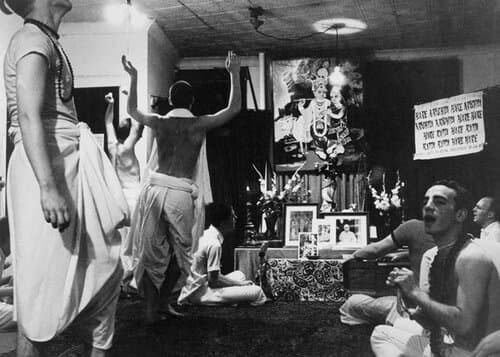
…when we came to preach the Hare Krishna movement in the West. When we came to New York in 1965, we never expected that the Hare Kṛṣṇa mahā-mantra would be accepted in this country. Nonetheless, we invited people to our storefront to join in chanting the Hare Kṛṣṇa mantra, and the Lord’s holy name is so attractive that simply by coming to our storefront in New York, fortunate young people became Kṛṣṇa conscious. Although this mission was started with insignificant capital, it is now going nicely. The spreading of the Hare Kṛṣṇa mahā-mantra in the West has become successful because the young people were not offenders. The youths who joined this movement were not very advanced as far as purity was concerned, nor were they very well educated in Vedic knowledge, but because they were not offenders, they could accept the importance of the Hare Kṛṣṇa movement. We are now very happy to see that this movement is advancing more and more in the Western countries. We therefore conclude that the so-called mlecchas and yavanas of the Western countries are more purified than offensive Māyāvādīs or atheistic impersonalists. (from purport Madya-lila 7.17.145)
This sentence jumped out at me ‘ but because they were not offenders, they could accept the importance of the Hare Kṛṣṇa movement’, and I wanted to understand what was meant by offenders. And I realized that Srila Prabhupada was refering to the Mayavada or Mayavadi Philosphy.
Mayavada and Mayavadis

Those who do not accept the Personality of Godhead, they are called Māyāvādīs. Māyāvādī means they see everything māyā. Even Kṛṣṇa is māyā. That is called Māyāvādī.
(Srila Prabhupada Lecture on Bhagavad-Gita 7. 1-3).
Mayavada is a doctrine which teaches that everything is illusion (maya =illusion, vada=teaching). Krishna consciousness, however, teaches that the total reality consists of the Supreme Person Krishna and His unlimited energies.
Mayavada philosophy rejects all forms and manifestations—as well as personality itself—as illusion. Advocates of this—mayavadis, or advaita vedantists—say that ultimately everything is “one,” and that the perfection of life is to merge with the ultimate oneness and again become nameless, formless, and devoid of personality.
Mayavadi interpretations of scriptures like the Bhagavad-gita and the Srimad Bhagavatam dismiss all names and forms of the Supreme Person as illusory, while emphasizing the impersonal aspect of the Absolute Truth.
Mayavadi philosophers believe that the Absolute Truth, being spread throughout the cosmic manifestation, has no personal form. But the standard Vedic version is that the Supreme Person is spread all over the cosmic manifestation by His energy. This energy is spiritual, but because it acts in the material world it is called maya, or illusory energy.
The Absolute Truth is understood in three phases—impersonal, localized, and as the Supreme Person. The Supreme Person’s impersonal feature, brahman, is subordinate to His personal aspect, as the sun’s rays are subordinate to the sun itself. Mayavada teachings accept only the impersonal Brahman as real, and think the Supreme Person, the source of Brahman, is illusory.
Chaitanya Mahaprabhu taught that those who present Mayavada interpretations of scripture are offensive to Krishna and should be avoided. This is because such persons deny Krishna’s existence as the Supreme Personality of Godhead, and claim that Krishna is as much an illusion as everything else.